In chronological order, the life of Jesus goes like this: his birth in Bethlehem and childhood in Nazareth, his baptism by John and temptation in the wilderness, an early ministry in Judea, a long ministry in Galilee full of miracles and parables, Peter's confession and the Transfiguration, a final journey to Jerusalem, Holy Week, the crucifixion, the resurrection, and the ascension. Below is a harmony-style list of the main events, with the Gospel passages for each one, followed by a simple way to watch, read and listen to it all in order.
Can the four Gospels be put in exact order?
Not perfectly, and the Gospel writers never claimed to be writing a diary. Luke says he set out "to write an orderly account" (Luke 1:3, NIV), and his Gospel and Mark's move broadly in sequence. Matthew gathers much of Jesus' teaching into large blocks by topic, like the Sermon on the Mount. John adds events the others leave out and organizes his Gospel around the Jewish festivals. He mentions at least three Passovers (John 2:13; 6:4; 11:55), which is why most people speak of a ministry of about three years.
Harmonies agree on the big shape and differ on some details. The list below follows a common harmony. Where an event appears in several Gospels, the main references are given. As for dates, Jesus is usually thought to have been born around 6–4 BC and crucified around AD 30 or 33.
1. Birth and childhood
- An angel announces John the Baptist's birth to Zechariah (Luke 1:5–25).
- Gabriel visits Mary in Nazareth (Luke 1:26–38); Mary visits Elizabeth (Luke 1:39–56).
- Joseph's dream (Matthew 1:18–25).
- Jesus is born in Bethlehem, and shepherds come to see him (Luke 2:1–20).
- Simeon and Anna meet him at the temple (Luke 2:21–38).
- The magi visit; the family flees to Egypt and later settles in Nazareth (Matthew 2).
- Twelve-year-old Jesus stays behind in the temple (Luke 2:41–52).
The Gospels are almost silent about the next eighteen years. Mark calls him "the carpenter" (Mark 6:3), and Luke says he was "about thirty years old" when he began (Luke 3:23).
2. Preparation and first signs
- John the Baptist preaches in the wilderness (Matthew 3:1–12; Luke 3:1–20).
- Jesus is baptized in the Jordan (Matthew 3:13–17; Mark 1:9–11; Luke 3:21–22).
- Forty days of temptation in the wilderness (Matthew 4:1–11; Luke 4:1–13).
- The first disciples: Andrew, Peter, Philip and Nathanael (John 1:35–51).
- Water into wine at the wedding in Cana (John 2:1–11).
- Jesus clears the temple at Passover (John 2:13–22).
- Nicodemus comes at night (John 3:1–21).
- The Samaritan woman at the well (John 4:1–42).
3. Ministry in Galilee
- Rejected in his hometown of Nazareth (Luke 4:16–30).
- The fishermen leave their nets (Mark 1:16–20; Luke 5:1–11).
- Healings in Capernaum, including Peter's mother-in-law (Mark 1:21–34).
- A paralyzed man is lowered through a roof (Mark 2:1–12).
- Matthew the tax collector is called (Matthew 9:9–13).
- The twelve apostles are chosen (Mark 3:13–19; Luke 6:12–16).
- The Sermon on the Mount (Matthew 5–7).
- Parables by the lake, including the sower (Matthew 13:1–52; Mark 4:1–34).
- Jesus calms the storm (Mark 4:35–41; Matthew 8:23–27; Luke 8:22–25).
- Jairus' daughter and the woman who touched his cloak (Mark 5:21–43).
- The twelve are sent out (Matthew 10; Mark 6:7–13).
- The feeding of the five thousand, the only miracle in all four Gospels (Matthew 14:13–21; Mark 6:30–44; Luke 9:10–17; John 6:1–14).
- Jesus walks on the water (Matthew 14:22–33; John 6:16–21).
For a closer look at the signs in this section, see the miracles of Jesus in video.
4. The road to Jerusalem
- Peter's confession at Caesarea Philippi (Matthew 16:13–20; Mark 8:27–30).
- Jesus first predicts his death (Mark 8:31–33).
- The Transfiguration (Matthew 17:1–9; Mark 9:2–10; Luke 9:28–36).
- Jesus "resolutely set out for Jerusalem" (Luke 9:51, NIV).
- The parable of the Good Samaritan (Luke 10:25–37).
- Martha and Mary (Luke 10:38–42).
- The lost sheep, the lost coin and the prodigal son (Luke 15).
- Jesus raises Lazarus at Bethany (John 11:1–44).
- Zacchaeus in Jericho (Luke 19:1–10).
Luke places many of the best-known parables on this journey. They are gathered in the parables of Jesus in video.

Watch “The Passion” in Sacred
The last days of Jesus as a cinematic series in short episodes, based on the Gospels.
4.8on the App Store
 Scan with your phone
5. Holy Week
- Mary anoints Jesus at Bethany (John 12:1–8).
- The triumphal entry on Sunday (Matthew 21:1–11; John 12:12–19).
- Jesus clears the temple and teaches there (Mark 11:15–19; Matthew 21–25).
- Judas agrees to betray him (Matthew 26:14–16; Luke 22:3–6).
- The Last Supper and the washing of feet (Matthew 26:17–30; Luke 22:7–38; John 13–17).
- Prayer and arrest in Gethsemane (Mark 14:32–52).
- Trials before Caiaphas, Pilate and Herod; Peter's denial (Mark 14:53–72; Luke 23:1–25).
- The crucifixion and burial (Matthew 27; Mark 15; Luke 23; John 19).
The meal on Thursday night is unpacked in the Last Supper in video.
6. Resurrection and ascension
- The women find the tomb empty (Matthew 28:1–10; Mark 16:1–8; Luke 24:1–12).
- Jesus appears to Mary Magdalene (John 20:11–18).
- The road to Emmaus (Luke 24:13–35).
- Jesus appears to the disciples, and a week later to Thomas (John 20:19–29).
- Breakfast by the lake and Peter restored (John 21).
- The Great Commission (Matthew 28:16–20).
- The ascension, after forty days (Luke 24:50–53; Acts 1:3–11).
What each Gospel adds to the timeline
- Matthew tells the birth from Joseph's side, includes the magi, and gathers Jesus' teaching into five long blocks, starting with the Sermon on the Mount.
- Mark is the shortest and fastest. It opens with the baptism and moves from one scene to the next with hardly a pause.
- Luke tells the birth from Mary's side, includes the shepherds, and places many of the parables on the long journey to Jerusalem.
- John adds the early ministry in Judea, the festivals that frame the whole timeline, long conversations like those with Nicodemus and the Samaritan woman, and the fullest account of the night before the cross.
How to watch, read and listen in order
A harmony is a map, not the territory. A few ways to use it:
- Read one Gospel straight through first. Mark is the shortest and moves fast. Reading it in one or two sittings gives you the shape before the details.
- Then follow the list, one section a week. Six weeks takes you from Bethlehem to the ascension. Read the references for each event and notice how each Gospel tells it a little differently.
- Watch the key scenes, then read them. A good adaptation helps you see the place, the crowd, the faces. This guide to the life of Jesus in video compares the main options.
- Listen when you are on the move. Hearing a Gospel narrated, chapter after chapter, is close to how its first audiences received it.
John explains why he wrote at all: "that you may believe that Jesus is the Messiah, the Son of God, and that by believing you may have life in his name" (John 20:31, NIV). The order matters because it leads somewhere.
How Sacred helps
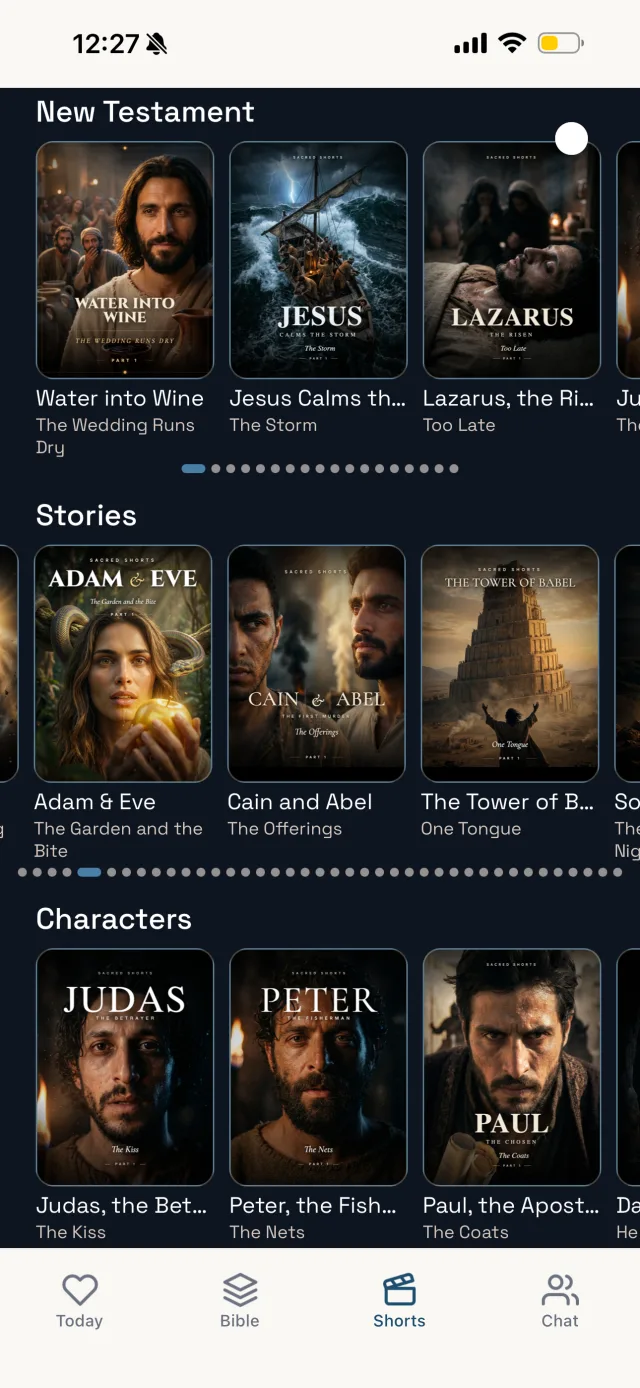
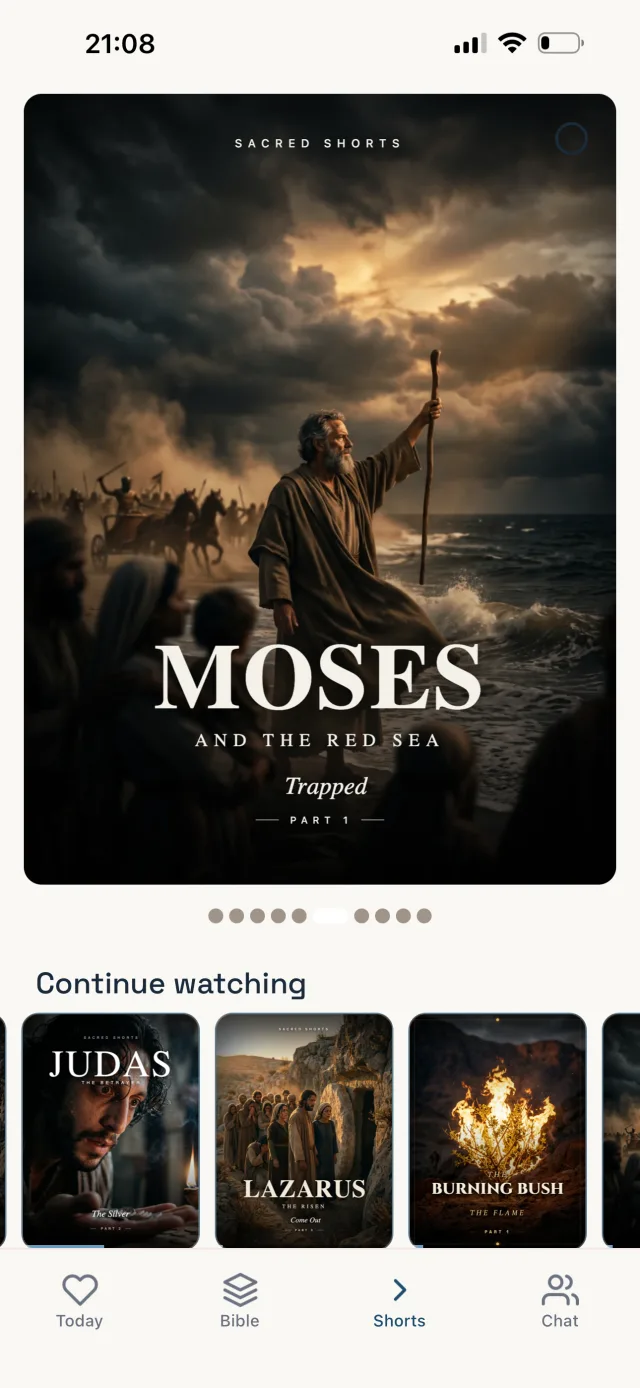
Sacred has cinematic series in short episodes for several moments on this timeline: "Water into Wine," "Peter, the Fisherman," "Jesus Calms the Storm," "Parables," "The Good Samaritan," "The Prodigal Son," "Lazarus, the Risen," "Judas, the Betrayer" and "The Passion." For the rest, all four Gospels are narrated chapter by chapter in the BSB, with each verse highlighted as it plays, adjustable speed, and audio that keeps going with the screen locked. You can read in the BSB or the KJV, save verses, and ask the Bible chat questions like why John's order differs from Mark's. The app has no ads and runs on iPhone and Android.
Where to begin
Start with Mark 1 tonight, or with Luke 1 if you want the birth narrative first. Keep this list open beside you. By the time you reach the empty tomb, the miracles, parables and conversations will no longer feel like separate scenes, but like one life moving steadily toward Jerusalem.
 Sacred Shorts
The life of Jesus, scene by scene
Watch “Water into Wine,” “Lazarus, the Risen” and “The Passion,” then listen to each Gospel narrated.
 Scan with your phone
Frequently asked questions
Most estimates say about three years, because the Gospel of John mentions at least three Passover festivals during his ministry. Some scholars argue for a shorter period, but around three years is the most common view.
None of them follows a strict timeline. Mark and Luke move broadly in sequence, Matthew groups much of Jesus' teaching by topic, and John adds events the others leave out, especially in Judea and around the Jewish festivals. Harmonies combine all four.
The Gospels say very little. After the visit to the temple at age twelve, Luke says Jesus grew in wisdom and stature, and Mark later calls him the carpenter from Nazareth. Luke notes he was about thirty when he began his ministry.
In the traditional order, Jesus enters Jerusalem on Sunday, clears the temple and teaches there during the following days, shares the Last Supper on Thursday evening, is arrested that night, is crucified on Friday and rises on Sunday morning.