
The Bible stories that matter most to adults are usually the ones we heard in a simplified version as kids: Cain's envy, Joseph's broken family, David's abuse of power, Elijah's collapse right after his greatest victory, Jonah's anger at God's mercy, Peter's failure and restoration. Below are 20 of them, grouped by the parts of adult life they speak to, each with the passage, a short summary, and why it reads differently now. Most of them can be watched as short series, and all of them can be read or heard.
Why Bible stories hit differently as an adult
Children's Bibles focus on the hero and the happy ending. Read as an adult, the same stories turn out to be about the long middle: the years Joseph spent in prison, the decades Moses spent in the desert before the burning bush, the night Jacob could not sleep because his brother was coming. The Bible does not clean up its people. It shows their envy, their lies, their grief, and their second chances.
You also bring more to the text now. A job, a marriage or a divorce, children or the lack of them, a loss you did not see coming, a failure you cannot undo. These stories were written for people with exactly those experiences, and they tend to open up when you do.
Stories about family, envy and failure
- Cain and Abel (Genesis 4:1–16). Two brothers, two offerings, one jealous anger. What adults notice is that God warns Cain before the murder, not after: "sin is crouching at your door; it desires to have you, but you must rule over it" (Genesis 4:7, NIV). It is a story about the moment before we act.
- Jacob wrestles through the night (Genesis 32:22–32). A lifelong schemer is about to face the brother he cheated. He wrestles until dawn and walks away limping, with a new name. Real change often leaves a mark.
- Joseph and his brothers (Genesis 37–50). Favoritism, betrayal, slavery, years in prison, and a reunion where Joseph weeps so loudly the Egyptians hear him. His verdict on it all: "You intended to harm me, but God intended it for good" (Genesis 50:20, NIV). If you want to see it before you read it, here is a guide to the story of Joseph in video.
- Samson and Delilah (Judges 13–16). Extraordinary strength and almost no self-control. It reads like the story of a gifted person who never took the gift seriously, and it ends in a prison mill with one last prayer.
- David, Bathsheba and Nathan (2 Samuel 11–12). The man who faced Goliath abuses his power, covers it up with a killing, and is confronted by a prophet with a story about a stolen lamb. Read Psalm 51 right after: it is David's response.
Stories about faith under pressure
- Abraham and Isaac on Mount Moriah (Genesis 22:1–19). The hardest chapter in Genesis, and adults read it as parents. It refuses easy answers and ends with a name for God: "The Lord Will Provide" (Genesis 22:14).
- Moses at the burning bush (Exodus 3–4). Moses is around eighty by the time he stands before Pharaoh (Exodus 7:7), and at the bush he has a list of reasons he is the wrong man. God does not answer with a pep talk but with a promise: "I will be with you" (Exodus 3:12).
- The twelve spies (Numbers 13–14). Ten experienced leaders come back terrified; two, Caleb and Joshua, see the same land differently. The majority wins the argument and a generation loses the promise. A sobering story for anyone who makes decisions by committee.
- Gideon (Judges 6–7). Found hiding in a winepress, he asks for sign after sign, then watches his army shrink from 32,000 to 300. God keeps choosing people who feel too small for the job.
- Esther before the king (Esther 4–5). A queen who has hidden her identity must decide whether to risk her life by entering the king's court uninvited. Mordecai's question, whether she came to her position "for such a time as this" (Esther 4:14), applies to anyone with influence they never asked for.
- Daniel in the lions' den (Daniel 6). His rivals at work cannot find anything wrong with his conduct, so they go after his prayer life. He keeps praying with the windows open. Office politics, with lions.

Watch these stories as short series
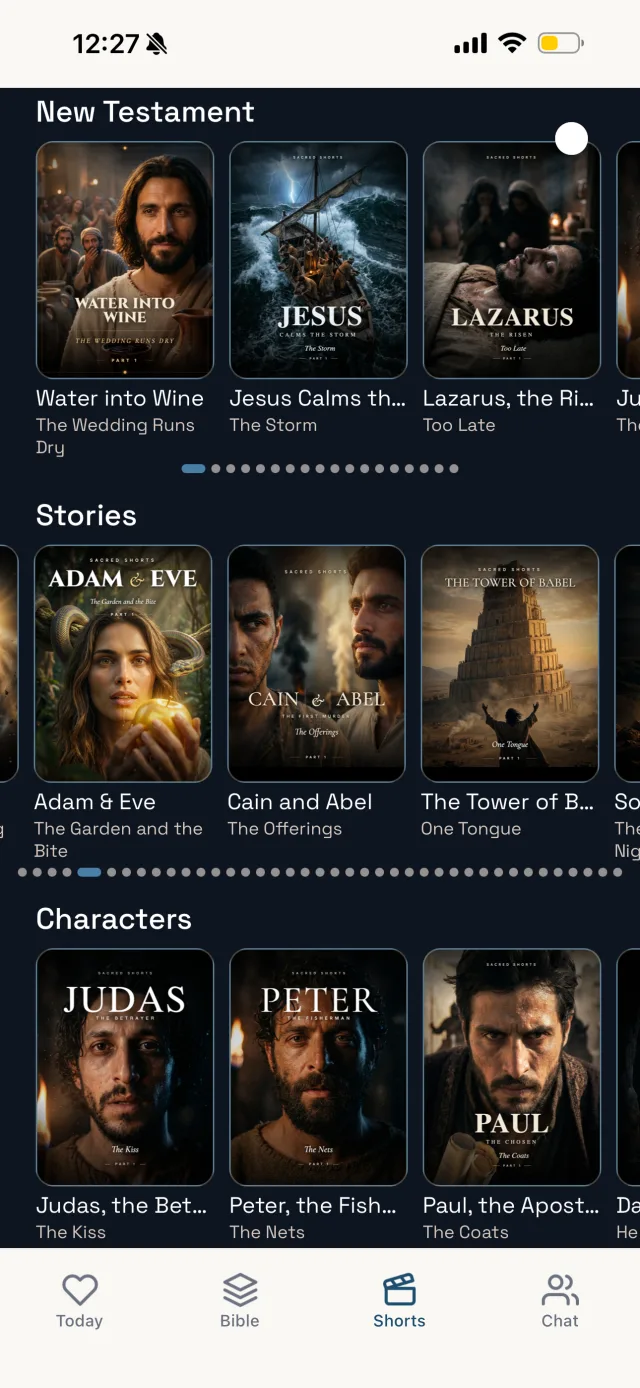
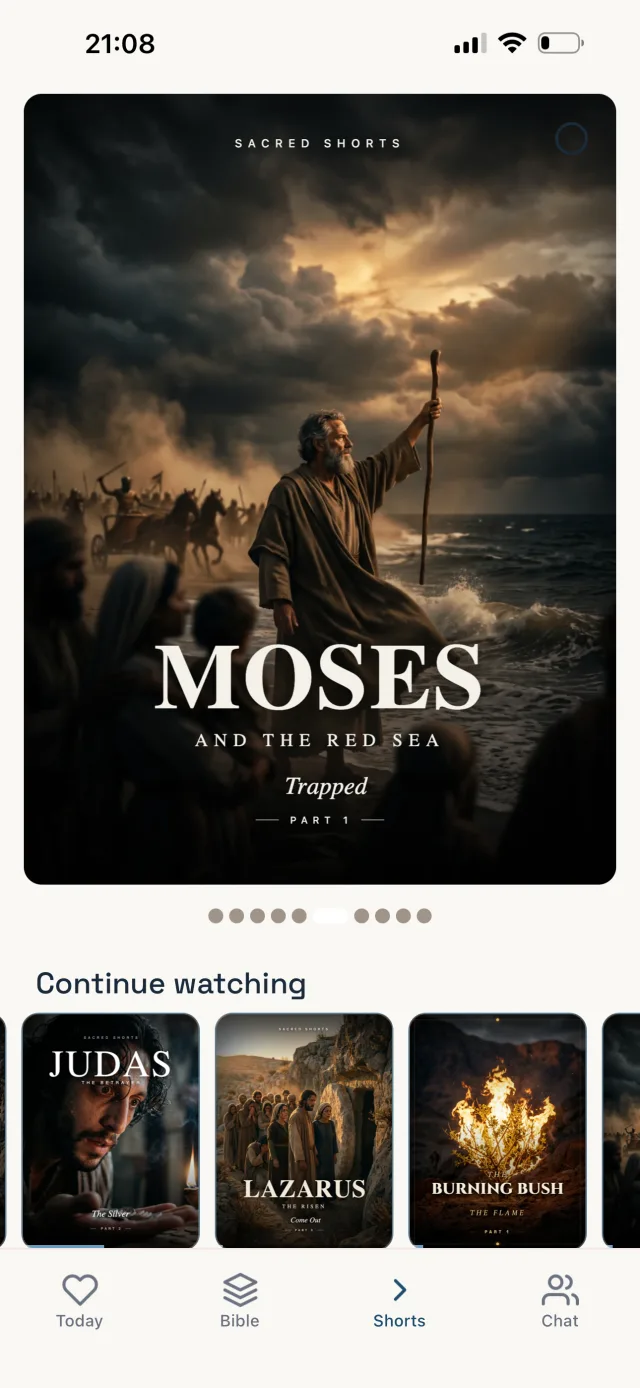
Joseph, Esther, Jonah, David and many more come to life as cinematic series in short episodes in Sacred.
4.8on the App Store
 Scan with your phone
Stories about grief, waiting and burnout
- Ruth and Naomi (Ruth 1–4). Naomi loses her husband and both sons and asks to be called Mara, "bitter." Ruth refuses to leave her. A quiet book about grief, being a foreigner, hard work and kindness. More on her in who Ruth was in the Bible.
- Hannah's prayer (1 Samuel 1). Years of infertility, a rival who taunts her, and a priest who mistakes her silent praying for drunkenness. Many adults find their own unspoken prayers here.
- Elijah under the broom tree (1 Kings 19:1–18). Right after the fire on Mount Carmel, Elijah runs, sits under a bush and tells God, "I have had enough, Lord" (1 Kings 19:4, NIV). God's first answer is sleep and food, not a lecture. See who Elijah was for the rest of his story.
- Job (Job 1–2; 38–42). Job loses almost everything, his friends offer tidy explanations, and in the end God rebukes the friends, not Job's honesty (Job 42:7). If the long middle feels heavy, start with the opening and closing chapters.
- Lazarus (John 11:1–44). Jesus arrives four days after the burial, hears both sisters say "if you had been here," and weeps at the tomb before he calls Lazarus out. "Jesus wept" (John 11:35, NIV) is short for a reason.
Stories about grace and second chances
- Jonah (Jonah 1–4). Everyone remembers the fish. Adults notice chapter 4, where Jonah sulks because God spared the city he hated. The book ends with God asking a question, and it is left for the reader to answer.
- The woman at the well (John 4:1–42). At noon, Jesus asks a Samaritan woman with a complicated past for a drink, and the conversation goes somewhere neither religious nor polite people would have taken it. She becomes the one who tells her whole town about him.
- The prodigal son and his older brother (Luke 15:11–32). Children hear about the younger son who comes home. Adults often realize they are the older one, standing outside the party, keeping score.
- Peter's denial and restoration (Luke 22:54–62; John 21:15–19). Peter swears he will never deny Jesus and does it three times before dawn, beside a charcoal fire. Later, at another charcoal fire by the lake, Jesus asks him three times, "Do you love me?" Few stories handle shame this gently.
How to take these stories in as an adult
You do not need a study program. A simple rhythm is enough:
- Watch first if the story feels worn out. A good adaptation breaks the flannelgraph version in your head. If you want options, this guide to Bible videos for adults compares the main ones.
- Then read the whole passage. Notice what the adaptation added, and what the text says that no film could show.
- Listen when you cannot sit still. Hearing a story narrated on a walk or a commute is how most believers through history received Scripture.
- Keep one question per story. Where am I in this? Cain at the door, the older brother outside, Elijah under the tree? One honest answer is worth more than ten pages of notes.
How Sacred can help
Sacred has cinematic series in short episodes about most of the people and stories on this list: "Cain and Abel," "Joseph," "Samson, the Strongman," "David," "Abraham and Isaac," "The Burning Bush," "The Twelve Spies," "Gideon," "Esther," "Daniel in the Lions' Den," "Lazarus, the Risen," "Jonah," "The Prodigal Son" and "Peter, the Fisherman."
For the ones without a series, such as Jacob, Ruth, Hannah, Elijah, Job and the woman at the well, the app narrates the full Bible chapter by chapter, with each verse highlighted as it is read, adjustable speed, and audio that keeps playing with the screen locked. You can read in the BSB or the KJV, save verses to your favorites, and ask the Bible chat the questions these stories raise, like why God accepted Abel's offering and not Cain's. There are no ads, and it works on iPhone and Android.
Where to start
Pick the group that matches your season right now. Worn out: Elijah. Carrying a grudge: Joseph or the older brother. Ashamed of something: Peter. Read or watch one story this week, slowly, and let it be about you before it is about anyone else.
 Sacred Shorts
Bible stories for grown-ups, in short episodes
Watch the series in Sacred, then read or listen to the full chapter in the narrated Bible.
 Scan with your phone
Frequently asked questions
Stories that deal with adult experiences work best: Cain and Abel on envy, Joseph on family betrayal, David and Bathsheba on power and repentance, Elijah under the broom tree on exhaustion, Ruth on grief, Jonah on resentment, and Peter's denial and restoration on failure and grace.
No. Most of them were written for adults and deal with violence, betrayal, infertility, grief, abuse of power and doubt. Children's versions simplify them, which is why rereading them as an adult often feels like reading them for the first time.
Combine formats. Watch a short adaptation to break the familiar version, read the full passage to see what the text actually says, and listen to it narrated during a walk or commute. Then ask one question: where do I see myself in this story?
There are dramatic series, word-for-word Gospel films and short-form apps. Sacred tells many of these stories as cinematic series in short episodes, and narrates the full Bible chapter by chapter for the ones you want to hear.