
The Last Supper is one of the most intimate scenes in the Gospels. Jesus is close to the cross, yet he is not distracted from love. He gathers his disciples at a table. He speaks of a covenant. He gives bread and the cup. He names betrayal without losing control of the moment. In John’s Gospel, he rises from the meal, takes a towel, and washes the feet of men who still do not understand how deep his humility goes.
A Bible video can help us slow down inside that room. It can show lamplight, silence, glances across the table, hands reaching for bread, and the heaviness of Jesus’ words. But the video is not the final authority. It is a doorway back to the Bible. The healthiest rhythm is simple: watch → read → reflect → pray. Watch the scene to awaken attention. Read the Gospel passages carefully. Reflect on what Jesus reveals about covenant, service, betrayal, and love. Pray in response to the Lord who gives himself.
The biblical context of the meal
The Last Supper takes place during the final days before Jesus’ crucifixion. In Matthew, Mark, and Luke, the meal is connected with Passover. That setting matters because Passover remembered God’s deliverance of Israel from Egypt, the blood of the lamb, and the mercy of God over his people. Jesus takes that memory and speaks of his own body and blood. He is not simply giving the disciples a private farewell. He is interpreting his death before it happens.
Matthew 26 and Mark 14 place the meal beside the announcement of betrayal. One of the Twelve will hand Jesus over. The disciples ask, “Is it I?” The question should not be rushed past. The table exposes not only Judas, but the weakness and confusion of all who sit with Jesus. Peter will speak boldly and then deny him. The others will scatter. Yet Jesus continues to give himself.
Luke 22 emphasizes the desire of Jesus to eat this Passover with his disciples before he suffers. He speaks of the new covenant and also addresses their argument about greatness. At the very table where Jesus gives himself, the disciples are still tempted to measure status. Jesus answers by describing greatness as service.
John 13 does not repeat the words over the bread and cup in the same way. Instead, John draws us into the washing of feet. Jesus knows that the Father has given all things into his hands, and he uses those hands to serve. He washes the feet of Peter, Judas, and the rest. The scene shows that the love of Christ is not abstract. It kneels.
Why this scene is powerful on screen
The Last Supper works on screen because it is quiet and dramatic at the same time. No battle is happening in the room, yet everything is charged with conflict. Jesus’ love is present. Betrayal is present. Confusion is present. The cross is near. A reverent video can help viewers notice the tension between ordinary details and eternal meaning: a table, a meal, a towel, bread, a cup, a command to love.
The camera can linger on the meal without turning it into spectacle. It can show the disciples’ uncertainty when Jesus mentions betrayal. It can hold on Peter’s discomfort as his feet are washed. It can let the viewer feel that Jesus is not being swept away by events. He knows what is coming, and he still chooses love.
Still, adaptation requires restraint. The Gospels do not tell us every expression, every pause, or every gesture. A video should not invent secret motives or turn the scene into religious theater detached from the text. It should make the viewer want to open Matthew, Mark, Luke, John, and 1 Corinthians, asking: What did Jesus actually say? What did the meal mean in context? How does each Gospel highlight a different angle of the same Lord?

The Bible has never felt like this
Watch this story come to life as a cinematic series in Sacred.
4.8on the App Store
Video helps us imagine, but Scripture remains first
A cinematic scene can make the Last Supper feel near. That is valuable because familiar holy moments can become flat through repetition. But no performance, soundtrack, or image can replace Scripture. The Bible gives the inspired witness. Video can support attention, but it cannot carry final authority.
This matters especially because Christians differ in how they understand and practice the Lord’s Supper, Communion, or Eucharist. Some traditions emphasize sacramental presence in one way; others speak differently about remembrance, participation, and mystery. A short video should not pretend to settle every theological difference. It can honor the biblical scene while sending viewers back to Scripture, pastoral teaching, and their church tradition with humility.
When you watch a video of the Last Supper, let it sharpen your reading instead of replacing it. Notice what the adaptation emphasized. Did it focus on the covenant words, the betrayal, the foot washing, the command to love, or the coming cross? Then ask how the biblical passages hold those themes together. If the video makes you more attentive to Jesus’ words, more sober about sin, and more grateful for his love, it has served its proper place.
A Scripture-first rhythm: watch → read → reflect → pray
First, watch with reverence. Do not treat the scene merely as religious atmosphere. Ask what stands out: the table, the bread, the cup, Judas’ nearness, Peter’s confusion, or the towel in Jesus’ hands.
Second, read slowly. Start with Luke 22:14–23, then compare Matthew 26:20–30 and Mark 14:17–26. Read John 13 for the foot washing and new commandment. Read 1 Corinthians 11:23–26 to see how the early church received and remembered the meal.
Third, reflect. What does Jesus reveal about the meaning of his death? How does he love disciples who are weak, confused, and soon to fail? Where do you need to receive his service before trying to serve others? What does it mean to remember him with seriousness and hope?
Finally, pray. You might pray, “Lord Jesus, bring me back to your table with humility. Teach me to receive your love, repent honestly, serve without pride, and remember your sacrifice through your Word.” Prayer turns the scene into response.
Where Sacred fits naturally
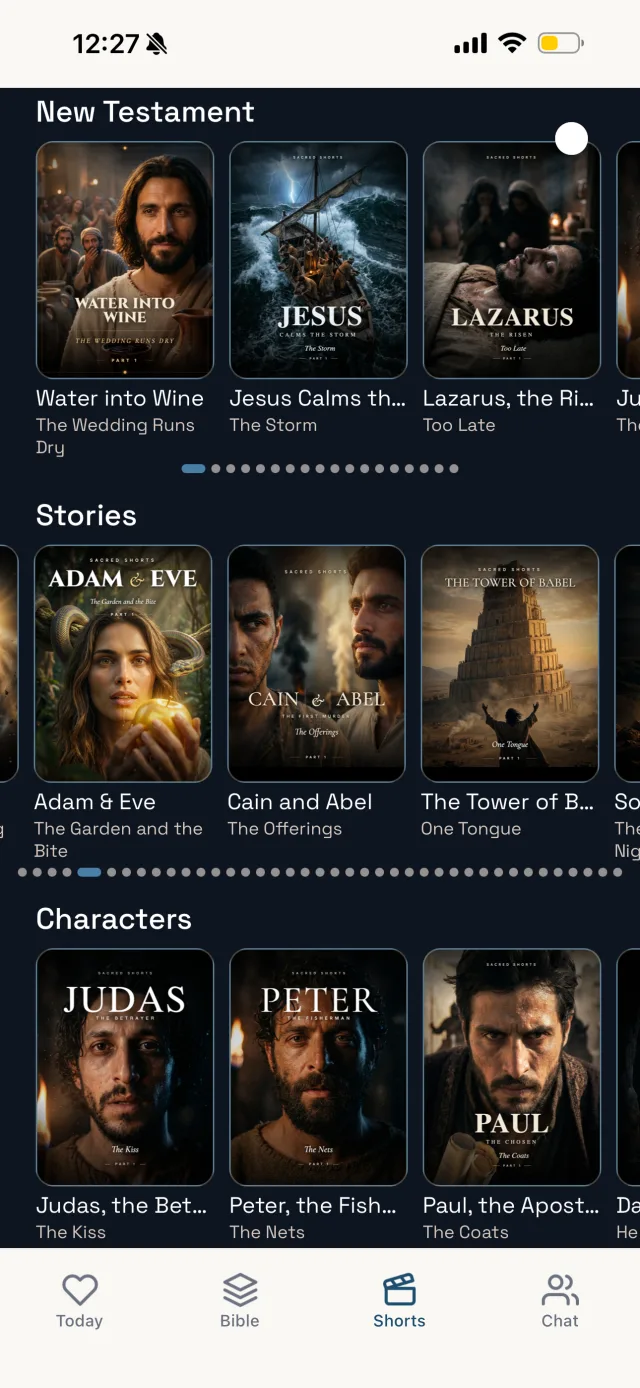
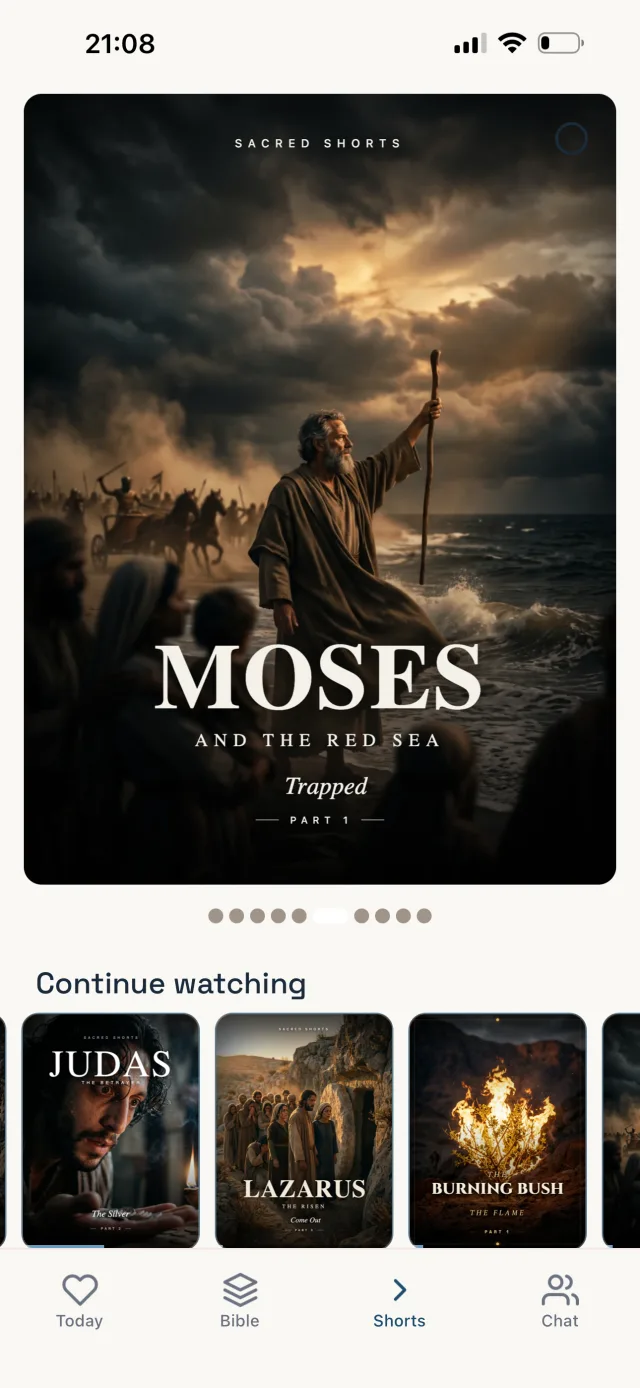
Sacred is built for this kind of rhythm. Sacred Shorts can help the Gospel scene feel vivid. The Study Bible brings you back to the chapters. AI Bible Chat can help you ask careful context questions about Passover, covenant, betrayal, and foot washing without treating a video as the final word. Guided Prayer can help you respond slowly before God.
Reading Scripture is always free in Sacred because the Word remains central. A short film may help you imagine the room. Scripture gives you the words of Jesus, the meaning of the meal, and the love that leads to the cross.
FAQ
What does the Last Supper reveal about Jesus?
It reveals Jesus as the one who gives himself in love, interprets his coming death, serves his disciples with humility, and remains faithful even in the presence of betrayal.
Why do Christians understand Communion differently?
Christian traditions differ in how they explain Christ’s presence, remembrance, mystery, and participation in the meal. Those differences should be handled with humility, Scripture, and pastoral guidance.
How should I use a video of the Last Supper devotionally?
Watch the scene, then read Matthew 26, Mark 14, Luke 22, John 13, and 1 Corinthians 11. Reflect on covenant, betrayal, service, and love, then pray from what the text reveals.
 Sacred Shorts
Watch the Bible like never before
Cinematic Bible stories, a complete Study Bible, daily devotionals, and guided prayer. New episodes every week.
Frequently asked questions
The Last Supper is described in the Gospels, especially Matthew 26, Mark 14, Luke 22, and John 13, with Paul also reflecting on the meal in 1 Corinthians 11.
The room, table, washing, bread, cup, betrayal, and words of Jesus make the scene vivid, but the meaning must still be tested by Scripture.
No. A video can help you imagine the room and feel the tension, but Scripture remains the source for understanding covenant, love, betrayal, and worship.