In chronological order, the Bible's main stories run like this: the beginnings in Genesis 1–11, the patriarchs from Abraham to Joseph, the Exodus and the wilderness, the conquest and the judges, the kings Saul, David and Solomon, the divided kingdom and its prophets, the exile and return, the life of Jesus, and the early church in Acts. The timeline below lists the key stories of each era with their passages and approximate dates, and marks the ones you can watch as a series in Sacred. Everything else can be read or heard in the narrated Bible.
Why the Bible is not printed in story order
Open a Bible and the books are grouped by kind: law, history, poetry, prophecy, Gospels, letters. That is useful for study, but the timeline jumps. First and Second Chronicles retell much of Samuel and Kings. Many of the prophets lived during the years covered by 1 and 2 Kings. Job sits in the middle of the Old Testament even though many readers place his story far earlier. Following the stories in order keeps the plot in view.
A word on dates: before King David, dates are debated. Where this list gives one, it follows the traditional chronology and says so. From the divided kingdom onward, dates match outside records more closely.
1. Beginnings (Genesis 1–11)
These chapters are not dated in a way historians can measure. They set the stage for everything after: a good world, a broken trust, and God's first promises.
| Story | Passage | In Sacred |
|---|---|---|
| Creation | Genesis 1–2 | Series: "Creation" |
| Adam and Eve and the fall | Genesis 3 | Series: "Adam & Eve" |
| Cain and Abel | Genesis 4 | Series: "Cain and Abel" |
| Noah and the flood | Genesis 6–9 | Series: "Noah and the Ark" |
| The Tower of Babel | Genesis 11:1–9 | Series: "The Tower of Babel" |
If you want the background before you watch, read the Tower of Babel in the Bible.
2. The patriarchs (Genesis 12–50)
Traditional chronologies place Abraham somewhere around 2000 BC; many scholars prefer a later or looser range. This era follows one family carrying a promise: land, descendants, and a blessing for all nations (Genesis 12:1–3). Many readers place Job's story in this same period, though his book never says.
| Story | Passage | In Sacred |
|---|---|---|
| The call of Abraham | Genesis 12 | Read and listen |
| Sodom and Gomorrah | Genesis 18–19 | Series: "Sodom & Gomorrah" |
| Abraham and Isaac on Mount Moriah | Genesis 22 | Series: "Abraham and Isaac" |
| Jacob and Esau, Jacob's ladder | Genesis 25–28 | Read and listen |
| Joseph, from the pit to Pharaoh's court | Genesis 37–50 | Series: "Joseph" |
3. The Exodus and the wilderness (Exodus to Deuteronomy)
The Exodus is usually dated either to the 15th century BC, following 1 Kings 6:1, or to the 13th century BC, depending on how the evidence is read. It is the Old Testament's great story of rescue, told in detail in the Exodus from Egypt in the Bible.
| Story | Passage | In Sacred |
|---|---|---|
| Moses at the burning bush | Exodus 3–4 | Series: "The Burning Bush" |
| The plagues and the Passover | Exodus 7–12 | Series: "The Plagues" |
| Crossing the Red Sea | Exodus 14 | Series: "Moses and the Red Sea" |
| The Ten Commandments at Sinai | Exodus 19–20 | Series: "The Ten Commandments" |
| The golden calf | Exodus 32 | Read and listen |
| The twelve spies | Numbers 13–14 | Series: "The Twelve Spies" |
| The death of Moses | Deuteronomy 34 | Read and listen |
4. The conquest and the judges (Joshua, Judges, Ruth)
Israel enters the land and then falls into a repeating cycle: it forgets God, is oppressed, cries out, and a judge rescues it. Ruth is set "in the days when the judges ruled" (Ruth 1:1, NIV).
| Story | Passage | In Sacred |
|---|---|---|
| Crossing the Jordan and Jericho | Joshua 3–6 | Read and listen |
| Deborah and Barak | Judges 4–5 | Read and listen |
| Gideon and the 300 | Judges 6–7 | Series: "Gideon" |
| Samson and Delilah | Judges 13–16 | Series: "Samson, the Strongman" |
| Ruth and Naomi | Ruth 1–4 | Read and listen |
5. The united kingdom (1 Samuel to 1 Kings 11), around 1050–930 BC
Israel asks for a king. Saul starts well and falters, David rises from the sheepfold, and Solomon builds the temple. David's reign is usually placed around 1000 BC.
| Story | Passage | In Sacred |
|---|---|---|
| Samuel is born and called | 1 Samuel 1–3 | Read and listen |
| Saul becomes king | 1 Samuel 9–10 | Read and listen |
| David and Goliath | 1 Samuel 17 | Series: "David" |
| David, Bathsheba and Nathan | 2 Samuel 11–12 | Read and listen |
| Solomon's wisdom and the temple | 1 Kings 3–8 | Read and listen |

Watch the Bible's story in order
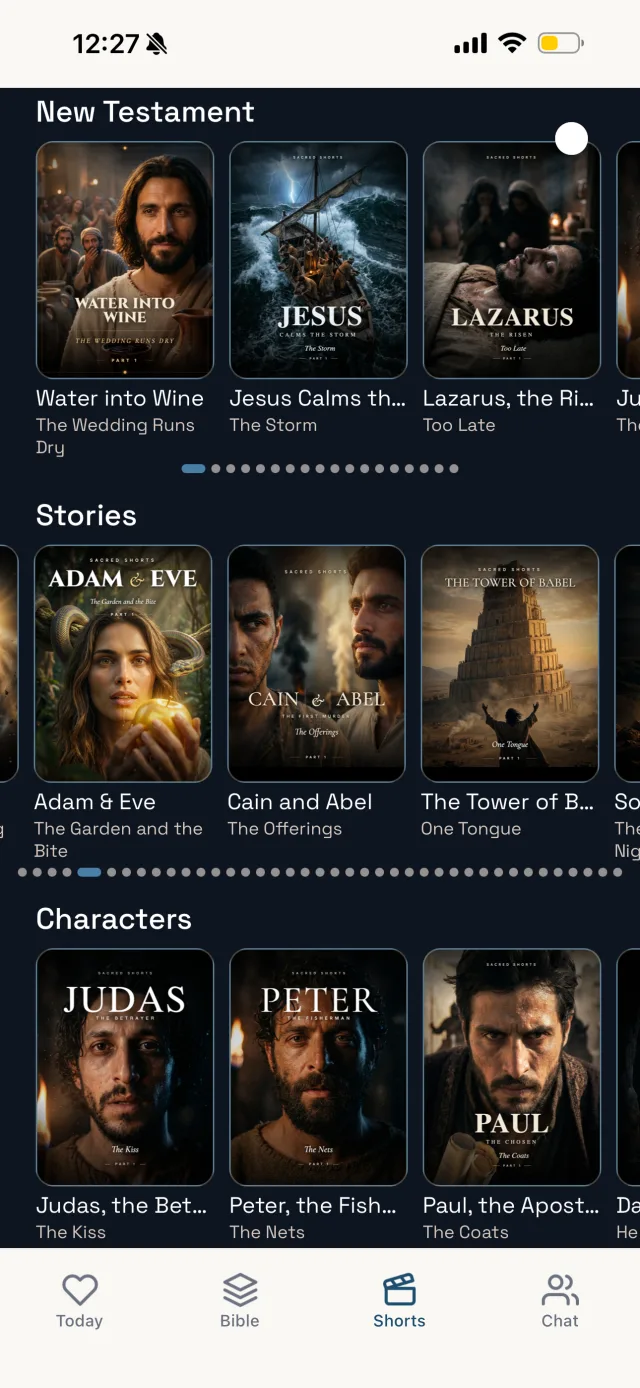
From Creation to Paul, Sacred tells the Bible's stories as cinematic series in short episodes.
4.8on the App Store
 Scan with your phone
6. The divided kingdom and the prophets (1 Kings 12 to 2 Kings 25)
Around 930 BC the kingdom splits in two: Israel in the north, Judah in the south. Israel falls to Assyria in 722 BC, and Judah falls to Babylon in 587 or 586 BC. Prophets like Elijah, Isaiah and Jeremiah speak into these centuries. Jonah appears in 2 Kings 14:25, during the reign of Jeroboam II in the 8th century BC.
| Story | Passage | In Sacred |
|---|---|---|
| The kingdom splits | 1 Kings 12 | Read and listen |
| Elijah on Mount Carmel | 1 Kings 18–19 | Read and listen |
| Naaman is healed | 2 Kings 5 | Read and listen |
| Jonah and Nineveh | Jonah 1–4 | Series: "Jonah" |
| Hezekiah and Isaiah | 2 Kings 18–20 | Read and listen |
| The fall of Jerusalem | 2 Kings 25 | Read and listen |
7. Exile and return (Daniel, Esther, Ezra, Nehemiah), 6th–5th centuries BC
In Babylon, Daniel and his friends stay faithful under foreign kings. Persia conquers Babylon in 539 BC and lets the exiles go home. Esther lives under the Persian king Xerxes, after the first return and before Ezra and Nehemiah reach Jerusalem.
| Story | Passage | In Sacred |
|---|---|---|
| The fiery furnace | Daniel 3 | Series: "The Furnace" |
| Daniel in the lions' den | Daniel 6 | Series: "Daniel in the Lions' Den" |
| The first exiles return | Ezra 1–6 | Read and listen |
| Esther saves her people | Esther 1–10 | Series: "Esther" |
| Nehemiah rebuilds the walls | Nehemiah 1–6 | Read and listen |
8. Between the Testaments
Roughly four centuries pass between the last Old Testament books and the Gospels. Greek rule, the Maccabean revolt, and the arrival of Rome in 63 BC shape the world Jesus is born into. The Protestant Bible has no narrative for this period.
9. The life of Jesus (Matthew, Mark, Luke, John)
Jesus is born around 6–4 BC, and his ministry ends with the crucifixion around AD 30 or 33. Paul sums up the timing: "when the set time had fully come, God sent his Son" (Galatians 4:4, NIV).
| Story | Passage | In Sacred |
|---|---|---|
| The birth of Jesus | Luke 2; Matthew 1–2 | Read and listen |
| Water into wine at Cana | John 2:1–11 | Series: "Water into Wine" |
| Peter leaves his nets | Luke 5:1–11 | Series: "Peter, the Fisherman" |
| Jesus calms the storm | Mark 4:35–41 | Series: "Jesus Calms the Storm" |
| The parables | Matthew 13; Luke 10; Luke 15 | Series: "Parables," "The Good Samaritan," "The Prodigal Son" |
| The raising of Lazarus | John 11 | Series: "Lazarus, the Risen" |
| Judas betrays Jesus | Matthew 26:14–16, 47–50 | Series: "Judas, the Betrayer" |
| The Last Supper and the cross | Matthew 26–27; John 13–19 | Series: "The Passion" |
| The resurrection | Matthew 28; Luke 24; John 20–21 | Read and listen |
10. The early church (Acts), around AD 30 to the early 60s
The story moves from Jerusalem to Rome. Acts ends with Paul under house arrest, still preaching. For a closer look at this era, see the early church in video.
| Story | Passage | In Sacred |
|---|---|---|
| The ascension and Pentecost | Acts 1–2 | Read and listen |
| Stephen, the first martyr | Acts 6–7 | Read and listen |
| Saul on the road to Damascus | Acts 9 | Series: "Paul, the Apostle" |
| Peter and Cornelius | Acts 10 | Read and listen |
| Paul's journeys | Acts 13–20 | Read and listen |
| Shipwreck and Rome | Acts 27–28 | Read and listen |
A simple way to follow the timeline
Take one era a week. Early in the week, watch or read the stories in the table. On the weekend, read one full chapter slowly. Ten weeks later you will have walked the whole storyline from Genesis to Acts. If you prefer to plan around films and series, this guide on how to watch the Bible in order covers that angle.
How Sacred helps
Sacred tells many of these stories as cinematic series in short episodes, so you can move through the timeline from "Creation" to "Paul, the Apostle" a few minutes at a time. For every story without a series, the full Bible is narrated chapter by chapter in the BSB, with each verse highlighted as it plays, speed control, and audio that keeps going with the screen locked. You can also read in the KJV, save verses to favorites, and ask the Bible chat where a story fits, for example whether Esther lived before or after Daniel. The app has no ads and runs on iPhone and Android.
Start at the beginning
The Bible is one long story, and it reads best that way. Tonight, start with Genesis 1. Next week, Abraham. By the time you reach Acts, the prophets and the kings will no longer feel like scattered names, but like chapters leading somewhere.
 Sacred Shorts
From Creation to the early church
Watch the series in story order, then listen to each chapter narrated with the verse highlighted.

 Scan with your phone
Frequently asked questions
No. The books are grouped by type, such as law, history, poetry, prophecy, Gospels and letters. Some books cover the same period, the prophets fit inside the history of the kings, and Job is placed among the poetry even though his story is usually set much earlier.
Creation in Genesis 1 and 2 comes first, followed by Adam and Eve, Cain and Abel, Noah and the flood, and the Tower of Babel. These opening chapters of Genesis are not dated, so they sit before any timeline historians can measure.
Esther lived in the Persian Empire during the reign of Xerxes, called Ahasuerus in many Bibles. That places her after Daniel and after the first exiles returned to Jerusalem, but before Ezra and Nehemiah arrived there.
Dates before King David depend on how certain biblical numbers and archaeological finds are interpreted, so scholars propose different ranges, especially for Abraham and the Exodus. From the divided kingdom onward, dates line up more closely with outside records.