To watch The Chosen with your Bible open, keep the Gospels within reach, pause whenever a scene reaches a moment the Gospels record, read that passage, and sort what you just saw into three groups: what comes from Scripture, what is historical background, and what was imagined for the story. The Chosen, created by Dallas Jenkins, is a multi-season drama about the life of Jesus whose first season came out in 2019. The series itself says it is based on the Gospels, that it adds backstories, characters and dialogue, and that viewers are encouraged to read the Gospels. This guide is a simple way to take that invitation seriously, alone or with a group.
What you need
- A Bible. Paper or an app, whichever you'll actually open. A translation you read easily is better than an impressive one you skim.
- A notebook or notes app. You'll jot down a few references and one or two questions per episode.
- The pause button. The whole method depends on stopping, not on watching straight through.
- Optional: a Gospel parallel. Many events appear in two, three or all four Gospels. Most study Bibles list the parallel passages in the margin or footnotes.
The three-group method
Every scene in a Bible drama falls into one of three groups. Learning to sort them is the main skill.
1. From Scripture. Events and words the Gospels actually record: Jesus turning water into wine at Cana, calling Matthew at the tax booth, speaking with a Samaritan woman at a well. When you hear a line of Jesus, try to find it. Often it's word for word; sometimes it's a paraphrase.
2. Historical background. Details that aren't in the text but reflect the first-century world: Roman occupation, how tax collectors were seen, fishing on the Sea of Galilee, Sabbath customs, tensions between Pharisees and other groups. These are usually reasonable, and a good study Bible can tell you more.
3. Imagined for the story. Backstories, invented characters, private conversations, personal conflicts. This is where a drama does most of its creative work, and it's fine, as long as you remember it isn't Scripture.
Here is how it plays out with one example. The Gospels tell us Peter was married: Jesus heals his mother-in-law (Mark 1:29-31), and Paul later mentions that Peter's wife traveled with him (1 Corinthians 9:5). That's group one. But the Gospels never give her name, her personality or a single conversation between them. Anything a series shows about their marriage is group three, built on a small group-one fact.
The same goes for Mary Magdalene. Luke says only that she was a woman "from whom seven demons had come out" (Luke 8:2, NIV) and that she supported Jesus' ministry. Her life before that is a blank page in the text, so any version of it on screen is imagined. Our profile of Mary Magdalene in the Bible gathers everything the Gospels actually say about her.
A routine for each episode
- Watch with your Bible open beside you. When you recognize a Gospel moment, pause and note the time.
- Find the passage. If you're not sure where it is, search a key phrase or use the table below.
- Read it out loud. Then ask: which words were the same? What did the scene add? What did it leave out?
- Finish the episode, then read the whole chapter. Context often changes how a single scene lands.
- Write one sentence. What did this passage show you about Jesus?
If that sounds like a lot, start smaller: one pause per episode, one passage, one sentence.

Keep the Gospels open on your phone
Read and listen to every chapter narrated in Sacred, with each verse highlighted as it plays.
4.8on the App Store
 Scan with your phone
Gospel scenes you'll recognize, and where to read them
Any drama about Jesus will reach some of the best-known moments in the Gospels. When you hit one, here's where to look.
| Gospel scene | Where to read it |
|---|---|
| The miraculous catch and the first disciples | Luke 5:1-11; Mark 1:16-20 |
| Water into wine at Cana | John 2:1-11 |
| Nicodemus comes at night | John 3:1-21 |
| The woman at the well | John 4:1-42 |
| Matthew called from the tax booth | Matthew 9:9-13 |
| The Sermon on the Mount | Matthew 5-7 |
| Feeding the five thousand | Mark 6:30-44; John 6:1-15 |
| Walking on the water | Matthew 14:22-33 |
| Peter's confession | Matthew 16:13-20 |
| The Last Supper | Luke 22:7-23; John 13 |
Notice that some scenes appear in several Gospels with different details. That isn't a problem to fix. Each writer chose what to include for his readers, and a drama has to do the same when it blends accounts into one scene.
Questions for small groups
These work for any episode. Pick three or four; you won't need them all.
- What did this episode show that comes straight from the Gospels? Let's read it out loud.
- What did the writers add, and why do you think they added it?
- Does the added material fit the person the Gospels describe, or pull against it?
- Which words of Jesus stayed with you? Can we find them in the text?
- Did seeing a character's doubts or struggles change how you read the passage?
- What is this passage asking of us this week?
If your group is new to this kind of discussion, our guide to Bible videos for small groups covers how to structure the evening, and these questions to ask after watching a Bible video add more options.
Keep the text as the measure
A well-made drama does something good: it helps you picture people as real, with families, jobs and fears. The risk is that over time you remember the show's version as if it were the Bible's. The early believers in Berea are a good model here. They listened to Paul eagerly and then "examined the Scriptures every day to see if what Paul said was true" (Acts 17:11, NIV). Watch with the same curiosity, and let the Gospels have the last word.
How Sacred can help you study along
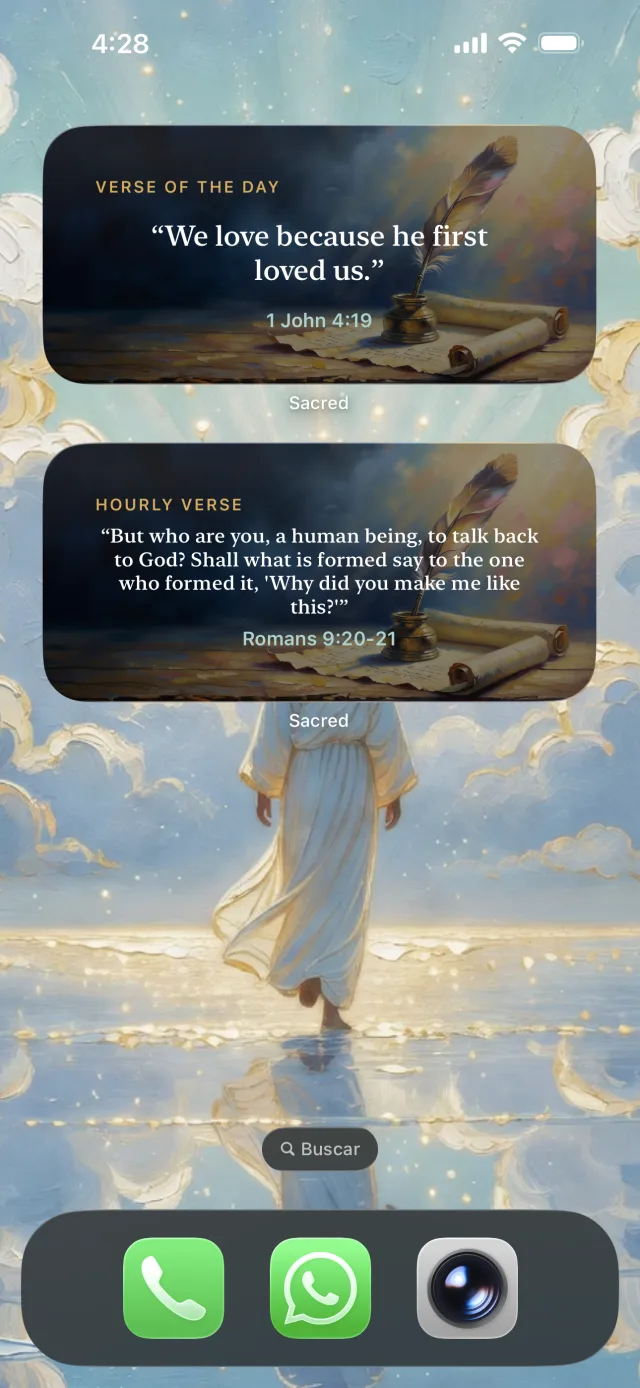
Sacred is a Bible app, and it's a practical way to keep the Gospels open while you watch. You can read in the Berean Standard Bible or the King James Version, or listen to any chapter narrated, with each verse highlighted as it's read, adjustable speed and audio that keeps going with the screen locked. That makes it easy to listen to John 4 on the drive home after your group meets, for example. Save the verses your group discussed as favorites, and if a question comes up, like who the Samaritans were or why tax collectors were hated, you can ask the AI Bible chat.
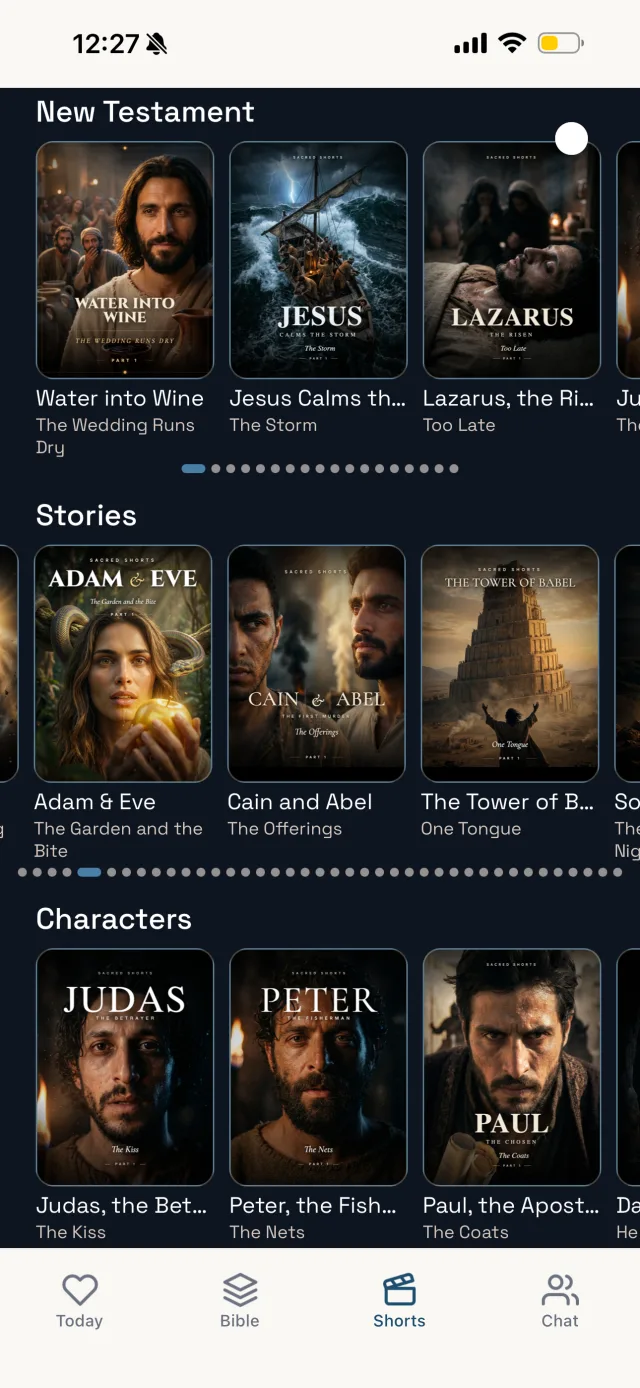
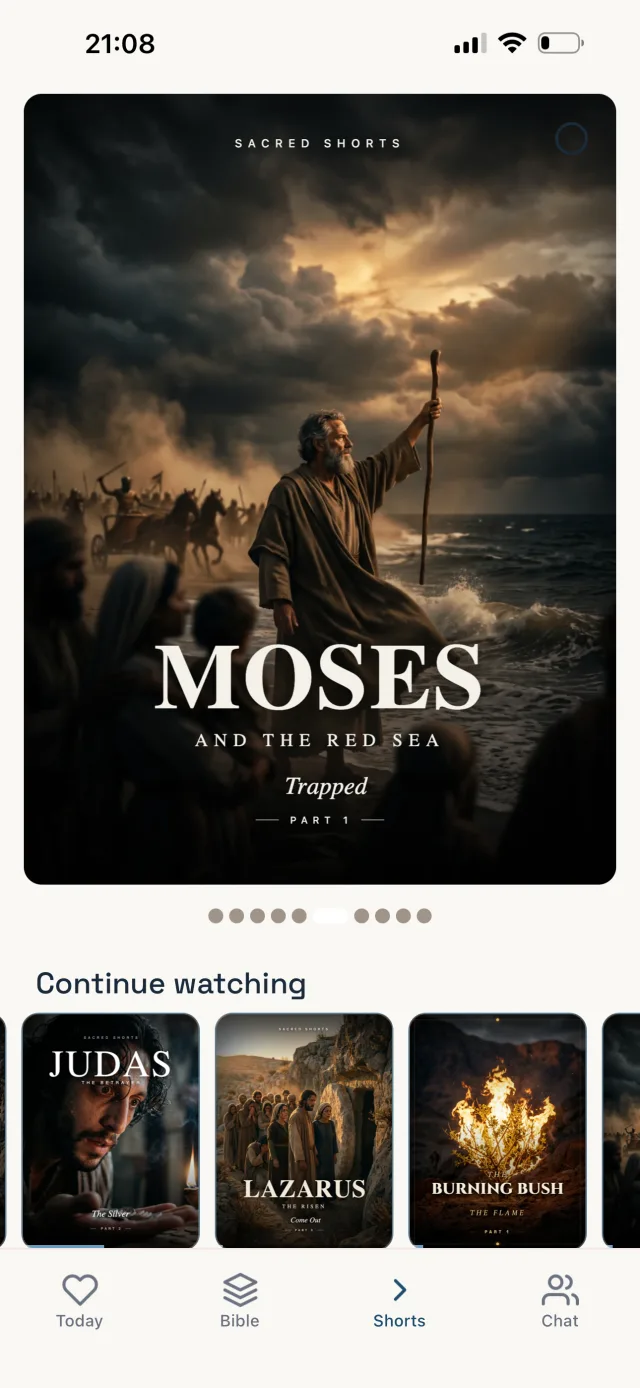
Sacred also has its own cinematic Gospel series in short episodes, such as "Water into Wine," "Jesus Calms the Storm," "Lazarus, the Risen," "Peter, the Fisherman" and "The Passion." They're another retelling, so the same three-group method applies to them too. For more ideas on what to watch between seasons, see what to watch after The Chosen.
Start with the next episode
You don't need a curriculum. Next time you sit down to watch, put a Bible on the couch beside you and pause once. Read the passage. Ask what was added. Over a season, that one habit will give you a much better grip on the Gospels, and a deeper sense of the Jesus they describe.
 Sacred Shorts
Watch the scene, then read the passage
Sacred has the complete Bible narrated, cinematic Gospel stories in short episodes and a chat for your questions.
 Scan with your phone
Frequently asked questions
The Chosen is based on the Gospels, but it is a drama. The series itself says that some timelines are combined or condensed and that backstories, some characters and dialogue have been added. Reading the Gospel passages behind each scene is the best way to know which parts come from Scripture.
Keep all four Gospels within reach: Matthew, Mark, Luke and John. Many scenes appear in more than one Gospel, so it helps to compare them. If you only pick one to start with, John is a good choice because several of its encounters with Jesus are told at length.
Watch one episode together, then read one or two of the Gospel passages it draws on out loud. Ask what came from Scripture, what was added and why, and what the passage asks of the group this week. Plan for about an hour and a half including the episode.
The Chosen was created by Dallas Jenkins. It is a multi-season drama about the life of Jesus and the people around him, and its first season came out in 2019.