A good small group does more than fill an hour on the calendar. It creates a place where people can open Scripture together, listen carefully, ask honest questions, and learn to follow Jesus in ordinary life. Bible videos can serve that kind of gathering well, especially when the group uses them as a doorway into the text rather than as the whole study.
A cinematic scene can help a room become attentive. People who arrive tired, distracted, or unsure what to say may find it easier to enter the story when they have seen a dusty road, a crowded house, a stormy lake, a table, a wilderness, or a quiet moment of prayer. Video can help the imagination wake up. It can make a familiar passage feel less distant and give the group shared details to discuss.
But the guardrail matters from the beginning: video helps us imagine and enter the biblical story, but it does not replace Scripture. Every Bible video is an interpretation. It chooses camera angles, pacing, faces, tone, music, and which details to include or leave out. Those choices may be beautiful and useful, but they are not the authority for the group. The biblical text remains the place where the group listens for God’s Word. A simple rhythm keeps that order clear: watch → read → reflect → pray.
Why Bible videos work well in small groups
Small groups often include people at different stages of faith. Some have read the Bible for years. Others are new, returning after a long time away, or quietly intimidated by Scripture. A short Bible video can give everyone a common starting point. Instead of beginning with a blank silence, the group begins with a scene: Jesus calling disciples, Ruth walking into a foreign field, Moses standing before Pharaoh, Peter stepping out of a boat, or Paul hearing Christ on the road to Damascus.
That shared experience can lower the barrier to conversation. Someone may say, “I noticed how afraid the disciples looked,” or “I had never thought about how public that healing was.” Those observations are not the end of study; they are invitations back into Scripture. The leader can then ask, “What does the passage actually say? What did the video help us notice? What does the text emphasize that the video could not fully show?”
Video also helps groups slow down. Many Bible studies move quickly from information to application. A scene can give space for attention before explanation. It invites the group to imagine real people, real places, real tension, and real mercy. The Bible is not less than true history, doctrine, poetry, and command, but much of it comes to us through story. Watching a scene can remind a group that God meets people in embodied moments, not only in abstract ideas.
A simple small group format
Begin with prayer, asking God for humility, clarity, and love. Then introduce the passage briefly. Name the book, chapter, and setting. If the group is watching a scene from the Gospels, say which Gospel the video is connected to. If it is from the Old Testament, locate it in the wider story of creation, covenant, exodus, kingdom, exile, or promise.
Next, watch one short video. Avoid stacking several scenes at once. Small groups usually go deeper when they give one passage room to breathe. After watching, pause for a minute of quiet. Let people write down what they noticed: a word, question, emotion, character, conflict, or detail.
Then read the Scripture aloud. This is the most important movement. Let someone read the passage slowly, and if the group is able, read it twice. The first reading gives the whole story. The second reading helps people notice structure, repetition, commands, promises, and surprising details. If traditions in the group use different translations, that can become fruitful, but keep the conversation charitable and focused on the meaning of the text.
After reading, reflect together. Good questions are simple: What does this passage reveal about God? What does it reveal about human need? What did the video help us imagine? What did Scripture correct, deepen, or clarify? Where do we see grace, warning, invitation, or obedience? What would it look like to respond this week?
Finally, pray. The group can pray sentence prayers from the passage. After a story of mercy, ask for mercy. After a call to discipleship, ask for courage. After a scene of repentance, confess honestly. After a promise, give thanks. Prayer keeps the study from becoming only discussion. It turns attention into response before God.

The Bible has never felt like this
Watch this story come to life as a cinematic series in Sacred.
4.8on the App Store
Leading without letting video take over
The leader’s role is not to defend every artistic choice in the video. It is to keep the group anchored. If someone asks, “Did it really happen exactly like that?” answer carefully: the passage is the source; the video is a reverent imagining of the scene. Encourage the group to compare what they saw with what they read.
This is especially important with passages where Christian traditions may emphasize different themes. Some groups will read certain texts through liturgical, sacramental, charismatic, evangelical, Catholic, Orthodox, or mainline lenses. A small group does not need to flatten those differences or turn every meeting into a debate. It can acknowledge that tradition matters while still asking what the biblical passage says, what Christians have commonly confessed, and where humility is needed.
Practical boundaries help too. Choose videos that are short enough to leave time for Scripture. Avoid making the meeting feel like entertainment night. Do not use the most emotionally intense clip simply because it gets a reaction. Reverence is more important than shock. The goal is not to impress people with cinematic power but to help them attend to God’s Word with a fuller imagination and a more responsive heart.
Discussion questions for any Bible video
You can reuse these questions with many passages. First, what part of the scene drew your attention, and why? Second, what details are clearly in the biblical text, and what details are artistic interpretation? Third, what does the passage reveal about God’s character, human weakness, or the way of faith? Fourth, what word, command, promise, or question should we carry into the week? Fifth, how can we pray this passage together right now?
Those questions keep the group from stopping at opinions about production quality. The best conversation is not “Was the video good?” but “How did this help us return to Scripture, see the passage more carefully, and respond faithfully?”
A gentle way to continue with Sacred
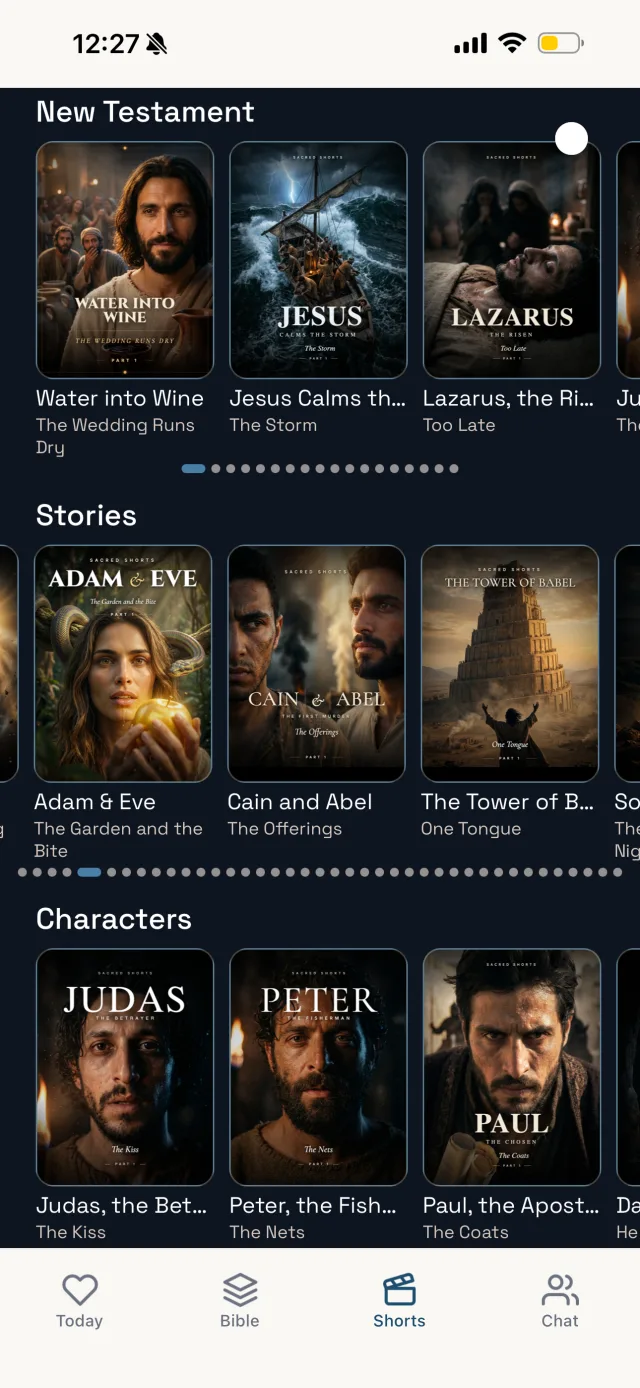
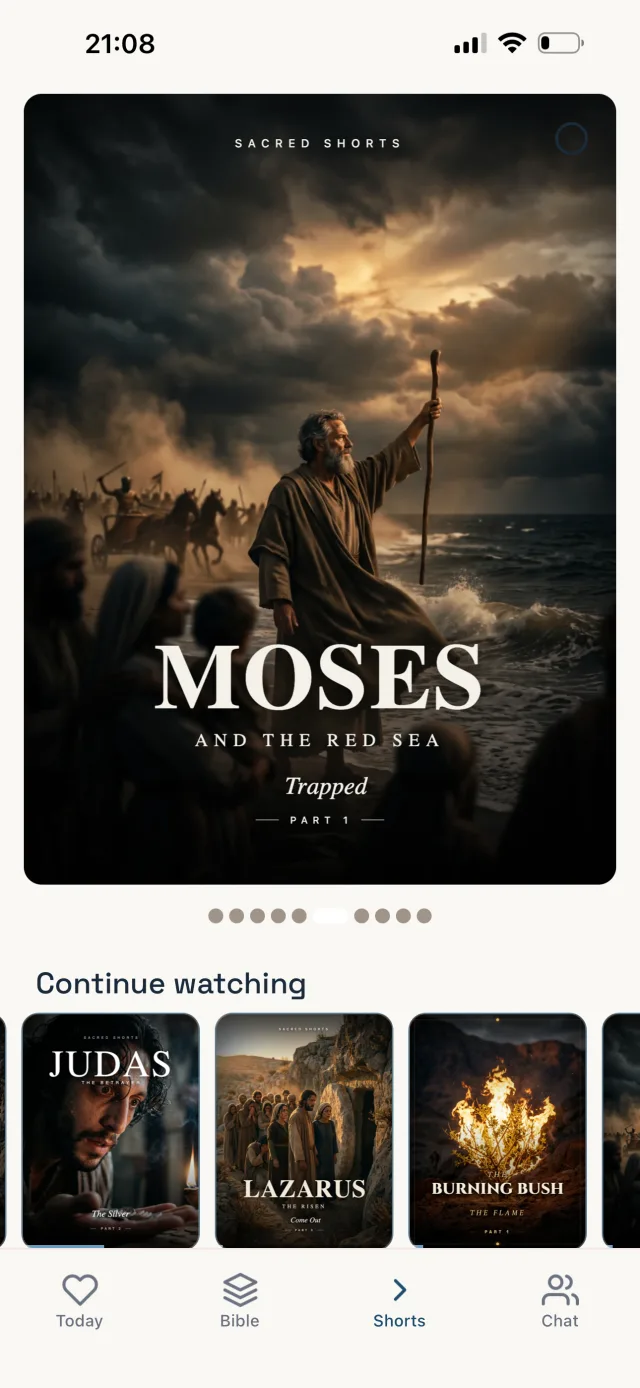
Sacred can help small groups keep this rhythm simple. Sacred Shorts offers cinematic biblical scenes for shared attention. The Study Bible keeps the passage close so the group can read before and after watching. Guided Prayer can help a group respond together, and AI Bible Chat can support thoughtful context questions while Scripture remains the foundation.
For your next gathering, choose one story. Watch it with attention. Read the passage aloud. Reflect with honesty. Pray together. The video may open the door, but Scripture is where the group learns to listen.
FAQ
Can a small group use Bible videos instead of a study guide?
A Bible video can support a study, but it should not replace Scripture or thoughtful discussion. Use the video as an opening doorway, then read the passage, ask questions, and pray from the text.
How long should the video portion be?
Keep it short enough that most of the meeting remains focused on Scripture, conversation, and prayer. One brief scene is usually better than several clips because it gives the group time to go deeper.
What if people disagree with details in the video?
Treat that as a reason to return to the passage. Ask which details come from Scripture and which are artistic choices. A respectful comparison can sharpen attention and keep the group grounded.
 Sacred Shorts
Watch the Bible like never before
Cinematic Bible stories, a complete Study Bible, daily devotionals, and guided prayer. New episodes every week.