
The best Bible app for a teenager is one they will open on their own, that keeps the actual Bible text close, respects their data and doesn't pull them into another endless feed. In practice that means four things: short formats that lead to a passage, content that is honest about the hard parts of Scripture, clear privacy, and features that support a small daily habit rather than more screen time. Below you'll find what to look for, what to avoid, and a checklist you can go through in about ten minutes before you install anything.
Why choosing for a teen is different
A teen's phone is already crowded with apps designed to hold attention. A Bible app enters that competition whether we like it or not. If it feels like homework, it gets ignored. If it copies the infinite scroll of social media, it wins attention for the wrong reasons. The sweet spot is something short and good-looking enough to open, with a clear finish line.
Teens also ask real questions about doubt, friendship, identity and suffering. Paul wrote to a young leader: "Let no one despise your youth, but set an example for the believers in speech, in conduct, in love, in faith, in purity" (1 Timothy 4:12, BSB). Teenagers can take Scripture seriously, and the app you pick should assume they can.
Short formats that lead somewhere
Short is not the enemy. A five-minute devotional or a brief video episode fits the gaps in a teenager's day: the bus, the wait before practice, the minutes before sleep. The test is what happens when the short thing ends.
- Good sign: the video or devotional points to the chapter it comes from, and opening it takes one tap.
- Good sign: there is a natural stopping point, so finishing feels like finishing.
- Warning sign: autoplay rolls into the next clip with no reason to stop.
- Warning sign: the Bible text is buried several menus deep.
If you want ideas for using short videos well, our guide to Bible videos for youth has practical ways to turn one scene into a conversation.
Honest content, including the hard parts
The Bible is not a collection of tidy moral lessons. It includes war, grief, betrayal, family conflict, failure and long stretches of doubt in the Psalms and Job. Teens notice quickly when adults sand those edges down, and they tend to trust a source less when it does.
Look for content that stays close to the text and doesn't tie every episode up with a neat lesson. Be realistic about age, too. Stories like Samson, the plagues of Egypt or the crucifixion are intense in the Bible itself, and a cinematic version carries some of that weight. With younger teens, watch one or two episodes first, or watch together.
Many apps now include an AI chat. Used well, it answers context questions in seconds. Used badly, it becomes the only voice a teen hears on faith. Tell your teen plainly that AI can be wrong and that big questions deserve a real conversation.
Privacy and data
Before installing, read the privacy section of the store listing ("App Privacy" on the App Store, "Data safety" on Google Play). Both summarize what the app collects. Then check:
- What it takes to sign up, and whether an account is required at all.
- Whether the app shows ads. Ad-supported apps often rely on tracking to target them.
- Whether there are social features, comments or messaging with people your teen doesn't know.
- What happens to what they type into a chat or a prayer journal.
- Whether in-app purchases are possible. Your phone's family or purchase settings can require approval.

Bible stories in short episodes
Watch a story in Sacred, then read the chapter it comes from.
4.8on the App Store
 Scan with your phone
Healthy screen habits built in
A Bible app should make the rest of life better, not just add screen time. Reminders at a time your teen chooses beat random pings. Streaks motivate some kids and stress others, so talk about it early: missing a day is not failing God, it is just Tuesday.
Pair the app with habits that don't need a screen: a paper Bible on the nightstand, church, youth group, a question at dinner. Our article on biblical principles for social media is a good one to read together if screen time is already a tense subject at home.
A parent's checklist
Go through this in ten minutes with the app open in front of you.
| Question | Why it matters | Good sign |
|---|---|---|
| Does a short video or devotional lead to the passage? | Keeps Scripture at the center | One tap to the chapter |
| Is there a clear end point? | Prevents endless scrolling | Episodes end, no forced autoplay |
| Does it handle hard stories honestly? | Builds trust | Close to the text, no fake bows |
| Are there ads? | Distraction and tracking | None |
| Who can contact your teen? | Safety | No messages from strangers |
| What does the AI chat do? | Accuracy | Points back to Scripture, admits limits |
| Can reminders be scheduled? | Healthy habit | User picks the time |
| Does it support audio? | Helps reluctant readers | Chapters narrated |
How to introduce it without making it a chore
Use the app yourself for a week first. Offer it instead of assigning it. Agree on one small moment of the day, like the ride to school. Once a week, ask which story they watched and what stuck. Let them pick. If you want a simple structure for that daily moment, see how to build a daily devotional habit.
How Sacred fits
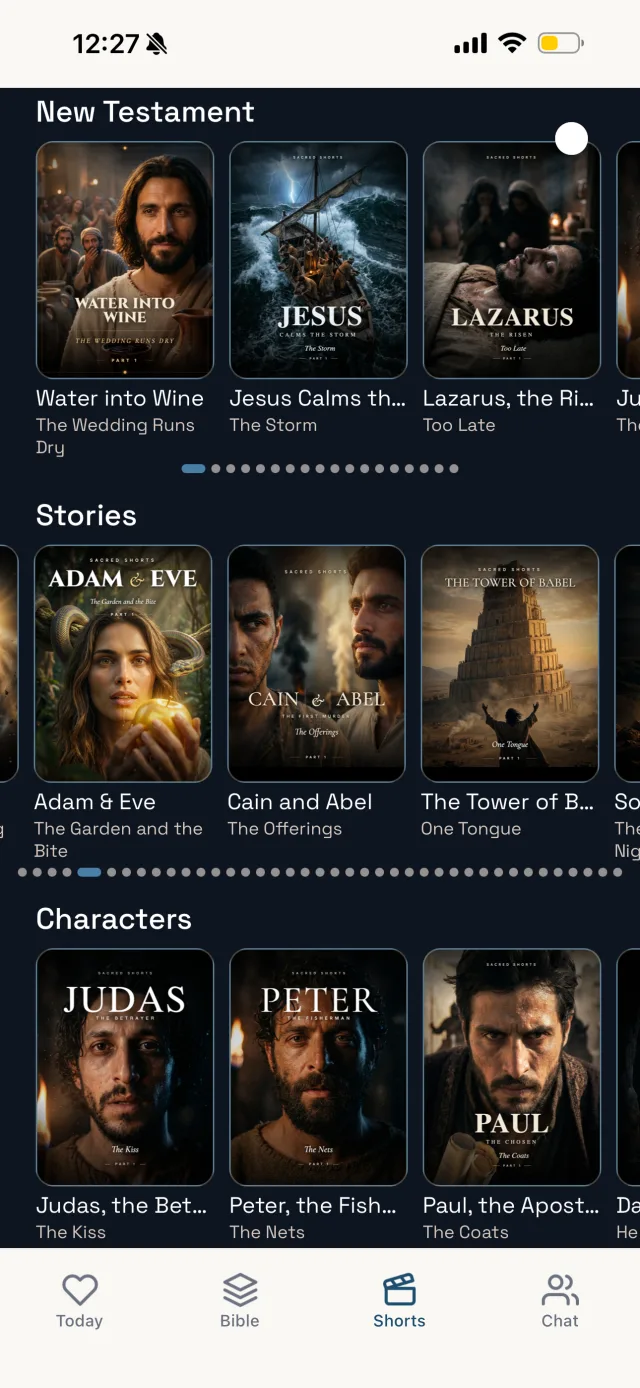
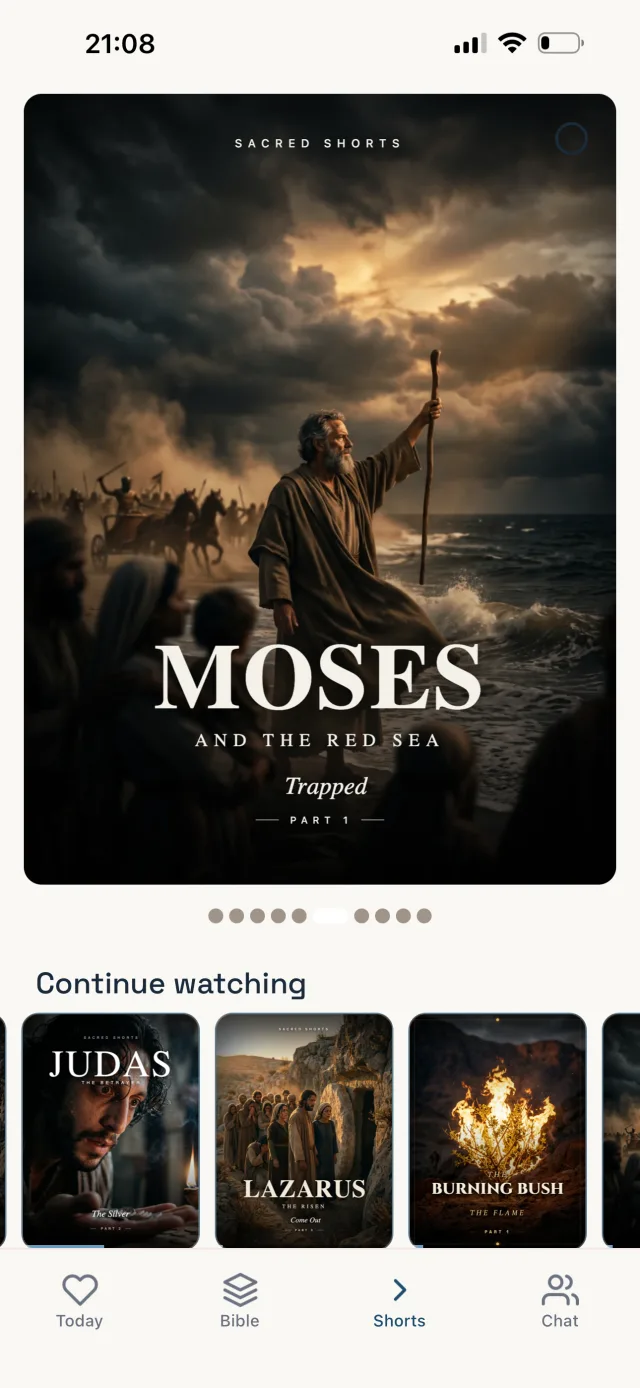
Sacred is built around short episodes. Its cinematic series follow Bible stories such as Creation, Joseph, David, Jonah, Daniel in the lions' den, Esther, Peter, Paul and the Passion. After an episode, the Bible is right there to read in the Berean Standard Bible (BSB) or the King James Version, and the whole Bible is narrated chapter by chapter with each verse highlighted as it is read. That helps teens who would rather listen than read.
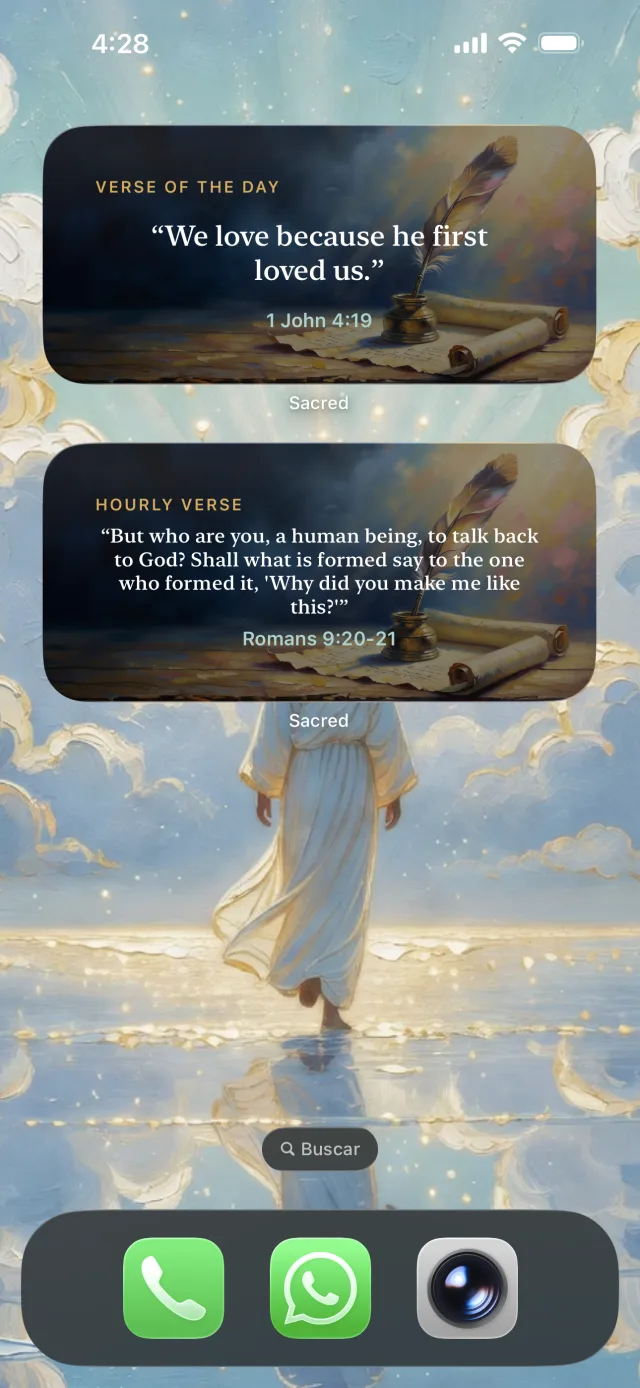
There is also a daily devotional with a verse, a short reflection and a narrated prayer, prayer reminders, a streak, favorites, verse widgets for iPhone and Android home screens, and an AI Bible chat for questions. Sacred has no ads.
What it isn't: it is not a youth group or a substitute for the conversations you have at home. The AI chat can get things wrong. Short videos are still screen time, so a good rule is one episode and then the chapter. Sacred is a paid subscription, so check the current price in your app store before you start. If your teen is looking for something to replace mindless scrolling, our piece on a Christian alternative to endless scrolling goes deeper into that.
The short version
Pick an app your teen will open, that sends them to the text, protects their data and attention, and ends when it should. Then stay in the conversation. "Your word is a lamp to my feet and a light to my path" (Psalm 119:105, BSB). The app can hold the lamp. You still get to walk the path with them.
 Sacred Shorts
A Bible app worth opening every day
Short cinematic Bible series, the full Bible narrated and a daily devotional, with no ads.
 Scan with your phone
Frequently asked questions
The one your teen will open without being told to: short formats that lead back to the Bible text, honest content, clear privacy, no ads, and a short daily habit instead of hours of scrolling.
It can help with quick context questions, like who the Pharisees were. Treat answers as a starting point, since AI can be wrong. Big questions about faith, doubt or identity deserve a conversation with a parent, pastor or youth leader.
Ten to fifteen minutes is plenty: one short story or devotional, the passage behind it and a brief prayer. If an app keeps them on the screen much longer, ask why.
No app is enough on its own. A good one makes Scripture easier to start, but faith grows through the Bible itself, prayer, conversations at home and a church where they are known.