To watch the Bible in order, follow the storyline of Scripture rather than the page order of its books: begin with Creation and the Fall, continue through the Flood, the patriarchs, and the Exodus, then the kings and prophets of Israel, and finish with the life of Jesus and the early church. This guide gives you that roadmap story by story, along with trustworthy films, series, and short-form videos for each era, so you can experience the whole Bible as one connected narrative.
Quick answer: key takeaways
- The Bible's books are grouped by type, not timeline, so a story-order viewing plan keeps the narrative clear.
- The core arc runs Creation → Fall → Flood → Patriarchs → Exodus → Kings → Prophets → Life of Jesus → Early Church.
- Mix formats: short vertical episodes for Old Testament stories, films like The Prince of Egypt for big moments, and series like The Chosen for the Gospels.
- Watching one era per week takes about two months to cover the whole storyline.
- Always pair each video with the passage it comes from; the video is the on-ramp, Scripture is the destination.
Why watch the Bible in story order?
Open a Bible and you will find the books grouped by genre: law, history, poetry, prophecy, Gospels, and letters. That arrangement is useful for study, but it means the timeline jumps around. Job sits in the middle of the book even though his story is ancient. The prophets appear after the histories they spoke into. Watching the Bible in narrative order fixes this: you see promises made in Genesis kept in the Gospels, and patterns set at the Red Sea echoed in the resurrection.
Jesus himself walked two discouraged disciples through Scripture this way, starting at the beginning and moving forward:
"And beginning with Moses and all the Prophets, he explained to them what was said in all the Scriptures concerning himself." — Luke 24:27 (NIV)
When you follow the same path, the Bible stops feeling like a shelf of disconnected books and starts feeling like one story with a beginning, a long middle full of longing, and a climax in Jesus. Story order also protects new viewers from the most common discouragement: starting strong in Genesis, stalling in Leviticus, and quitting before ever meeting David or hearing the Sermon on the Mount. A narrative roadmap simply skips ahead to the next scene of the drama, the way any good storyteller would.
The story-by-story viewing roadmap
Here is the order to follow. Work through it at whatever pace fits your life; each stage lists the key stories to look for on screen.
- Creation (Genesis 1–2). Start where everything starts: God speaking light, sea, land, and life into being, and forming humanity in his image. If you want the background first, read the creation of the world in the Bible before you press play.
- The Fall (Genesis 3). The serpent, the fruit, and the moment everything fractured. Understanding the fall of Adam and Eve explains why the rest of the Bible is a rescue story. Watch for Cain and Abel here too, the first bitter fruit of the Fall.
- The Flood (Genesis 6–9). Noah, the ark, judgment, and the rainbow covenant. The full narrative is unpacked in Noah and the Flood in the Bible.
- The Patriarchs (Genesis 12–50). Abraham's call, Isaac, Jacob's wrestling, and Joseph's rise in Egypt. These four generations carry God's promise from one family toward a nation.
- The Exodus (Exodus 1–20). The burning bush, the plagues, Passover, and the crossing of the Red Sea. This is the Old Testament's defining act of salvation and the era with the strongest film adaptations.
- The Kings (1 Samuel–2 Chronicles). Israel asks for a king: Saul falters, David rises (watch for David and Goliath), Solomon builds the temple, and the kingdom splits and slides.
- The Prophets (Isaiah–Malachi, with 2 Kings and Daniel). Elijah on Mount Carmel, Isaiah's promises of a suffering servant, Jeremiah's tears, Daniel in exile, and the long wait for Messiah.
- The Life of Jesus (Matthew, Mark, Luke, John). The Gospels are the summit of the whole viewing plan: birth, teaching, miracles, the raising of Lazarus, the betrayal by Judas, the cross, and the empty tomb. For a guide to the strongest adaptations, see the story of Jesus in video.
- The Early Church (Acts and beyond). Pentecost, Peter and Paul, the gospel spreading from Jerusalem to Rome, and letters written to young churches learning to live the story out.

The Bible has never felt like this
Watch this story come to life as a cinematic series in Sacred.
4.8on the App Store
Where can you watch each era?
No single production covers the whole Bible, so the best plan combines a few trusted sources. These are well-known options and what each does best:
| Resource | Best for | Format and length | Cost |
|---|---|---|---|
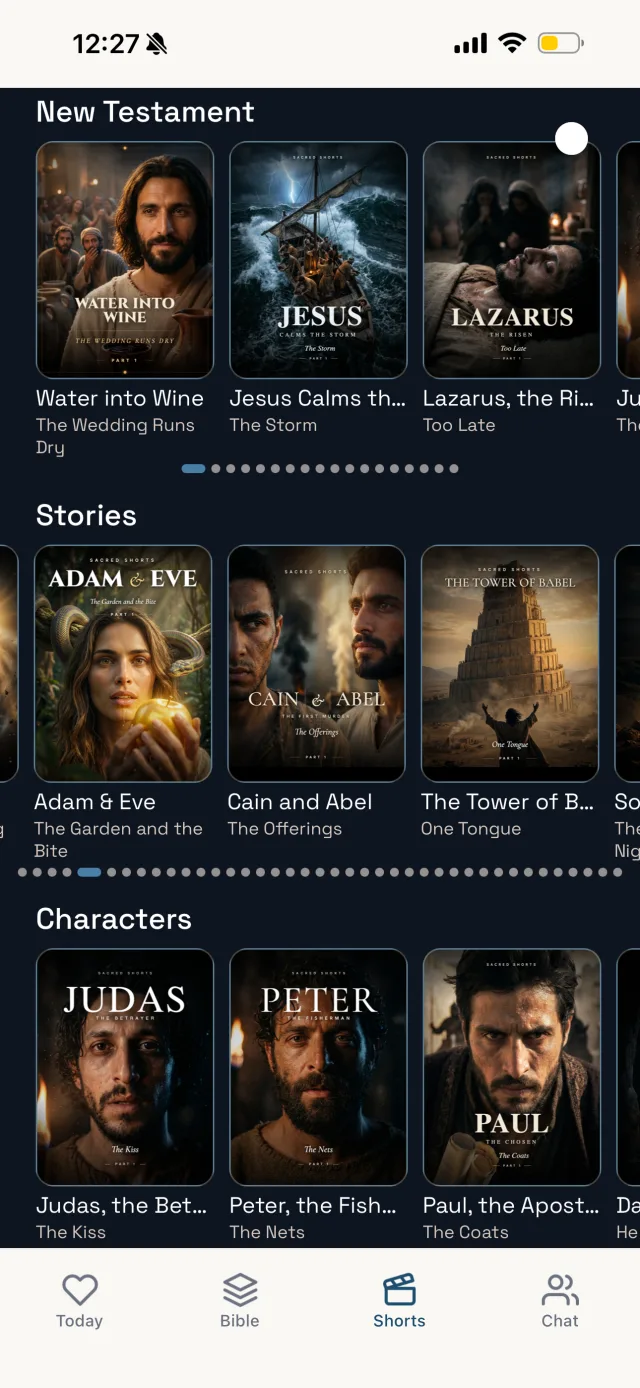
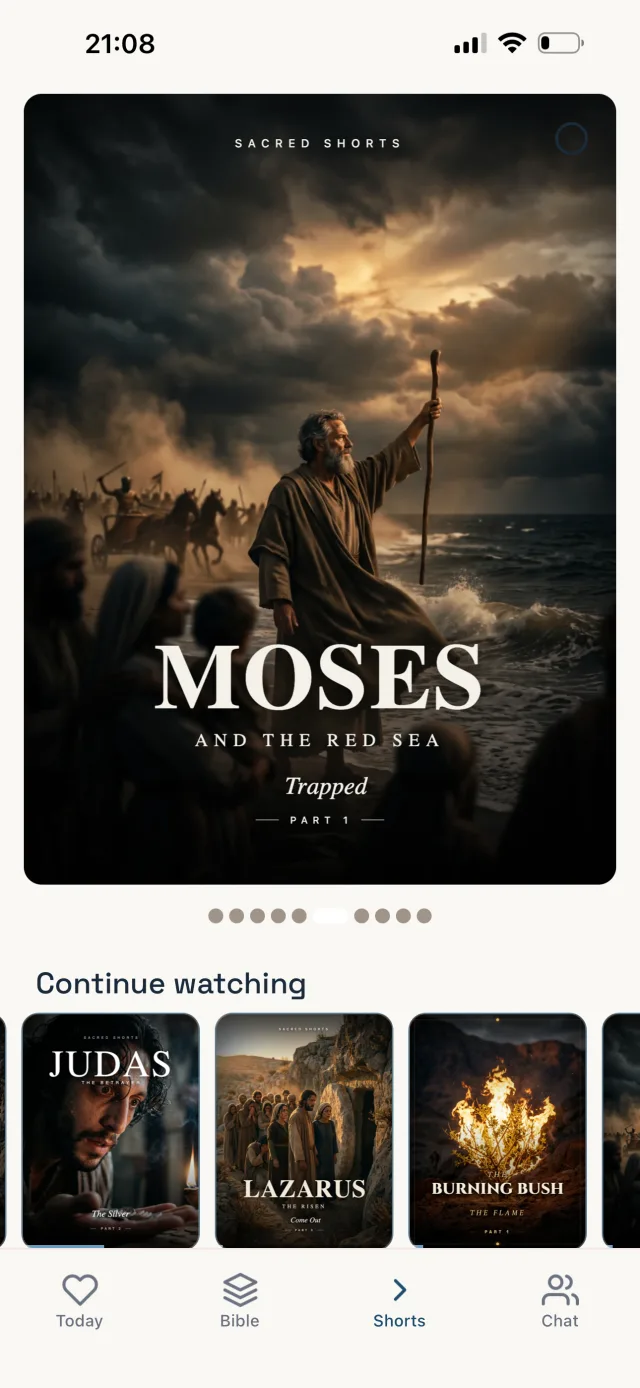
| Sacred Shorts (Sacred app) | Old Testament stories: Creation, Adam & Eve, Cain & Abel, The Burning Bush, The Plagues, Moses and the Red Sea, plus Lazarus and Judas | Cinematic vertical episodes, a few minutes each; new series weekly | Free app (iOS & Android) |
| The Chosen | The life of Jesus and his disciples | Multi-season drama series, ~50-minute episodes | Free to stream |
| BibleProject | Animated overviews that connect every era | 5–10 minute explainer videos | Free on YouTube |
| The Prince of Egypt | The Exodus as a family movie night | Animated feature film, ~99 minutes | Rent or stream |
| Superbook | Kids following the same storyline | Animated episodes, ~25 minutes | Free episodes online |
| LUMO Project | Word-for-word Gospel films | Feature-length, narrated straight from the Gospel text | Free to stream |
A practical combination: use short-form episodes and animated overviews for the Old Testament arc (stages 1–7), then switch to The Chosen or the LUMO Gospel films for the life of Jesus, and finish Acts with BibleProject's overview videos. If you are deciding between long and short formats, this comparison of Bible series versus Bible movies can help you choose.
How long does it take to watch the Bible in order?
That depends on the depth you want, but here are two realistic paces:
- The two-month plan. Take one era per week. Watch two or three short videos early in the week, then a longer film or episode on the weekend, and read the key chapters as you go. You will finish the full arc in about nine weeks.
- The story-a-day plan. Watch one short story each evening. Because short vertical episodes run just a few minutes, even the busiest season of life can absorb this pace, and you will move through the Old Testament in a few weeks.
There is no deadline. The goal is not to finish fast but to let the story do its work:
"For the word of God is alive and active. Sharper than any double-edged sword, it penetrates even to dividing soul and spirit, joints and marrow; it judges the thoughts and attitudes of the heart." — Hebrews 4:12 (NIV)
How to get more out of each story
A few habits turn passive watching into real engagement:
- Read after you watch. Every adaptation makes choices. Open the actual passage afterward and notice what the filmmakers kept, added, or left out.
- Keep a one-line journal. After each story, write a single sentence: what did this reveal about God? Nine eras later, you will have a personal map of the whole Bible.
- Watch with someone. A spouse, a friend, your kids. One question ("What surprised you?") is enough to start a conversation.
- Pray the story back. If you watched the Red Sea, thank God for the ways he has made a path for you.
"Your word is a lamp for my feet, a light on my path." — Psalm 119:105 (NIV)
Your next step: start at the beginning tonight
You do not need a perfect plan, a study guide, or a free weekend. You need the first story. Tonight, watch a short episode on Creation, then read Genesis 1 before you sleep. Tomorrow, the Fall. Within a week you will feel the momentum of the storyline pulling you forward, which is exactly how the Bible was meant to be experienced. If you want to go deeper on any single narrative along the way, the Bible Stories collection breaks down each one passage by passage.
 Sacred Shorts
Watch the Bible like never before
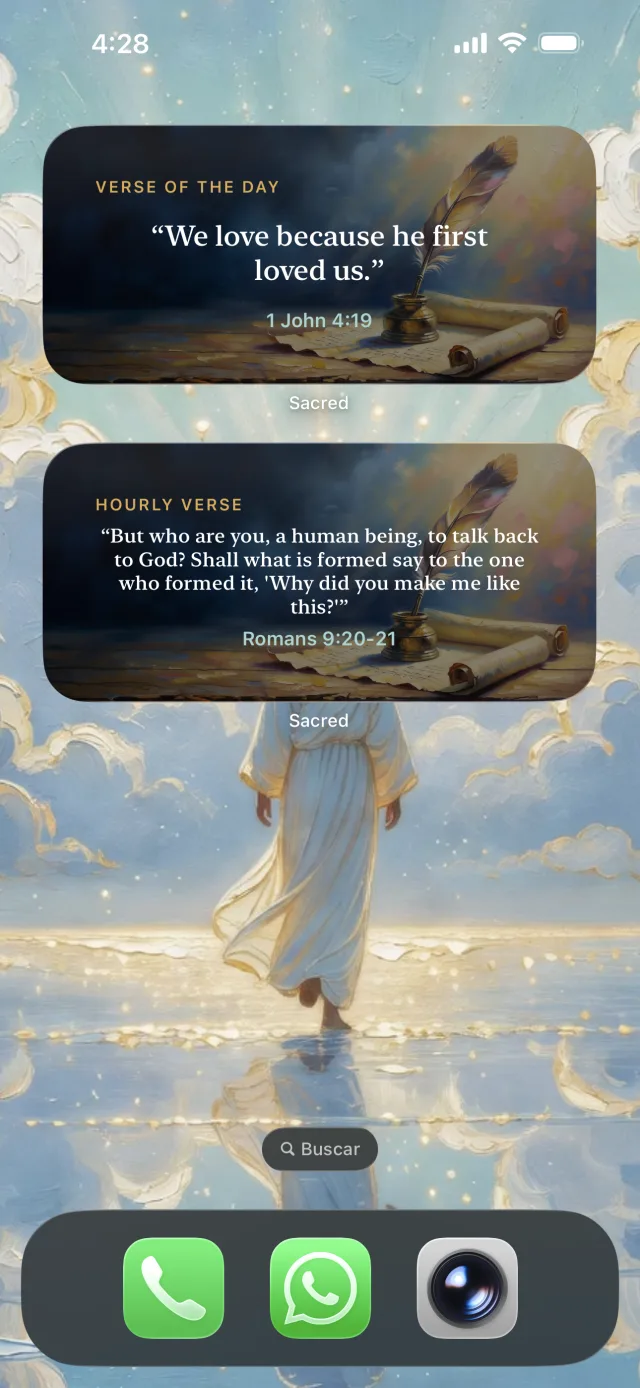
Cinematic Bible stories, a complete Study Bible, daily devotionals, and guided prayer. New episodes every week.
Frequently asked questions
Follow the storyline of Scripture rather than the page order of its books: Creation, the Fall, the Flood, the patriarchs, the Exodus, the kings, the prophets, the life of Jesus, and the early church. This narrative order shows how the whole Bible tells one connected story.
Not exactly. The books are grouped by type, such as law, history, poetry, prophecy, Gospels, and letters, so reading or watching front to back can feel disjointed. Following the story arc from Genesis to Acts keeps the timeline clear.
It depends on the pace you choose. Covering one era per week with a mix of short videos and a film or series episode takes about two months. Watching one story every evening moves faster, while a season of The Chosen alone takes several weeks.
No, and it does not need to. Videos are an on-ramp that makes the storyline vivid and easy to follow, but the inspired text itself carries the full depth. The best approach is to watch a story, then read the passage it comes from.