The best Bible videos for youth groups are short, visually strong, and honest to the text: think BibleProject's animated explainers, clips from The Chosen, LUMO's word-for-word Gospel films, and short-form story episodes like Sacred Shorts that match the vertical format teens already live in. But the video itself is only half the answer. This guide covers which resources to use, how to build a lesson around a clip instead of losing the room to a screen, and the discussion questions that turn watching into faith.
Quick answer: key takeaways
- Teens are visual-first; a well-chosen video levels the field between church kids and first-timers.
- Keep clips to 3–10 minutes; the video opens the conversation, it does not replace it.
- Top resources: The Chosen (drama), BibleProject (animated explainers), Sacred Shorts (short vertical story episodes), LUMO Project (word-for-word Gospels), Superbook (younger teens).
- A reliable lesson structure: hook video → read the passage → discuss → respond.
- Ask questions with no "right answer" trapdoor; teens go silent when they sense a quiz.
Why does video work so well with teens?
Today's students think in clips. That is not a lament; it is a ministry fact, and it can serve the gospel. Video does three things for a youth room that a cold-open Bible reading struggles to do:
- It levels the field. In any group you have students raised on Scripture sitting next to students who have never opened a Bible. A video gives everyone the same starting picture, so the newcomer can discuss Cain and Abel as confidently as the pastor's kid.
- It disarms. A teen who would stiffen at "turn to Genesis 4" will lean into a cinematic scene. Once the story has them, the text feels like discovering the source, not doing homework.
- It respects their format. Short vertical video is the native language of this generation. Meeting them there is the same instinct that has always driven good youth ministry: go where they are, then walk together somewhere deeper.
There is one caution worth naming. Video only serves discipleship when it leads somewhere; a youth ministry that is all clips and no text produces fans of Bible content rather than readers of the Bible. The structure below is designed to prevent exactly that, by making the screen the shortest part of the night.
Scripture is unembarrassed about young people engaging the Word early and seriously:
"How can a young person stay on the path of purity? By living according to your word." — Psalm 119:9 (NIV)
And it insists teens are not the church of tomorrow but participants now:
"Don't let anyone look down on you because you are young, but set an example for the believers in speech, in conduct, in love and in purity." — 1 Timothy 4:12 (NIV)
What are the best Bible videos for youth groups?
These are the established resources, with honest notes on where each shines in a youth setting:
| Resource | Format and length | Best youth use | Cost |
|---|---|---|---|
| The Chosen | Dramatic series, ~50-minute episodes | Clip a 5–8 minute scene about Jesus for the hook, or host occasional full-episode nights | Free to stream |
| BibleProject | Animated explainers, 5–10 minutes | Introducing a book or theme before a teaching series | Free on YouTube |
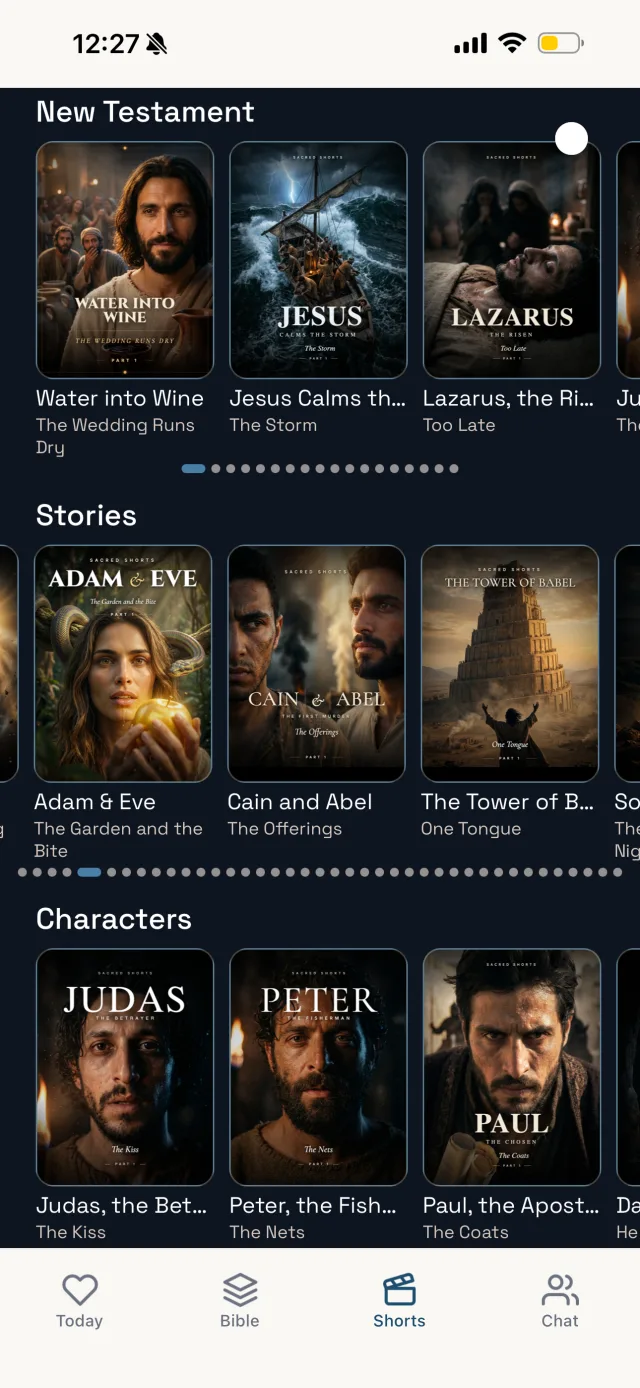
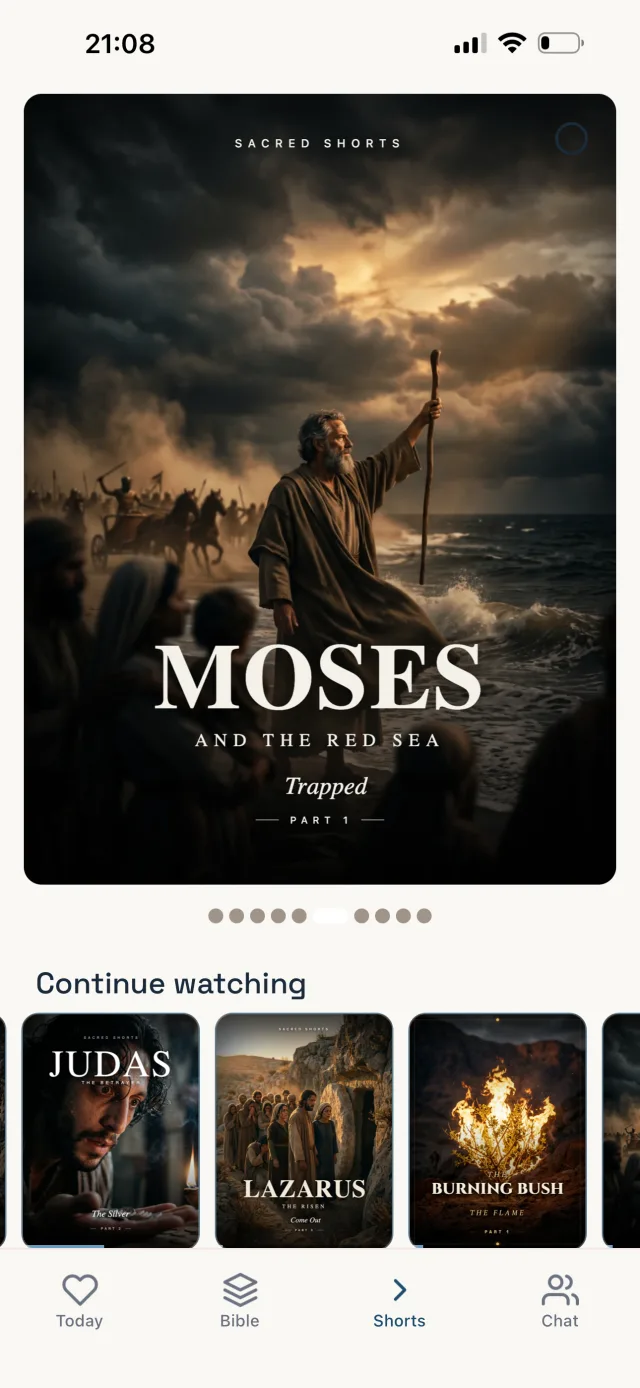
| Sacred Shorts (Sacred app) | Cinematic vertical episodes, a few minutes each | Story-driven lessons (Cain & Abel, Judas, Lazarus, The Burning Bush, The Plagues, Moses and the Red Sea); the format teens already use, new series weekly | iOS and Android (subscription) |
| LUMO Project | Word-for-word Gospel films | Showing that the actual biblical text is dramatic on its own | Free to stream |
| Superbook | Animated episodes, ~25 minutes | Middle schoolers and younger teens | Free episodes online |
| The Prince of Egypt | Animated feature, ~99 minutes | Movie nights and retreat sessions on the Exodus | Rent or stream |
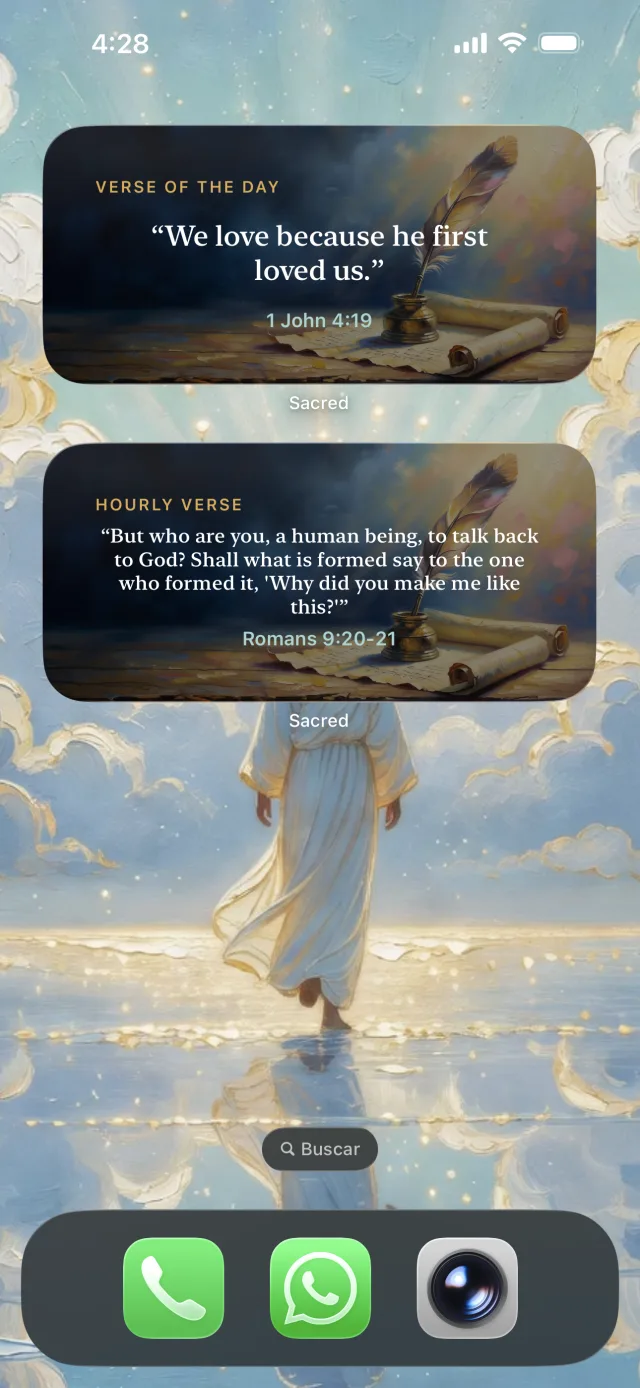
Because the Sacred app also includes a full Bible reader and an AI-powered Bible Chat, students can move from a story episode to the passage without changing apps, useful for the "read it yourself this week" challenge. For younger siblings and children's ministry, this guide to animated Bible stories for kids covers the age-appropriate end of the spectrum.

The Bible has never felt like this
Watch this story come to life as a cinematic series in Sacred.
4.8on the App Store
How do you build a youth lesson around a video?
The video should be the doorway, not the room. This four-part structure keeps the screen in its place and takes about 45 minutes.
1. Hook: play the clip (5 minutes)
Open with the video before any framing. Let the story land on its own. A short episode on Noah and the Flood or the Red Sea needs no introduction; that is the point of using it.
2. Read: open the actual passage (10 minutes)
Have students find the passage and read it aloud in parts. Then ask the comparison question that makes teens instant close-readers: "What was different in the text from what we just watched?" Spotting differences requires real attention to Scripture, and they will do it eagerly because it feels like catching something.
3. Discuss: go from story to life (20 minutes)
Move from observation to meaning to application (question ideas below). Small circles of three or four get quiet students talking better than one big circle.
4. Respond: one concrete challenge (5 minutes)
End with a single doable challenge tied to the story, for example: watch the next episode in the series this week and read the chapter it comes from. Keep it to one challenge, name it out loud, and open the next meeting by asking who actually did it; teens take a challenge seriously in exact proportion to whether the leader remembers it. If your students are drowning in schoolwork and sports, the anchoring ideas in short Bible videos for busy people translate directly to a teenager's schedule.
Discussion questions that actually get teens talking
Teens go silent when they smell a quiz. Ask questions where honesty is the only qualification:
- "What moment in that video stuck with you, and why?"
- "Which character do you think you'd actually be in this story? Not the one you should be."
- "What was different between the video and the passage? Does the difference matter?"
- "What does this story assume about God? Do you find that easy or hard to believe?"
- "If this story happened today, where would it happen? Who would be involved?"
- After a fall-and-consequence story like the fall of Adam and Eve: "Where do you see people, including us, hiding the way Adam hid?"
Two rules make these work. First, let silence sit; the first honest answer usually comes after the uncomfortable pause. Second, never correct a first answer, or you will not get a second one from anyone.
A few practical notes on the screen itself, learned the hard way by most youth leaders: always preview the full clip before the meeting, including the seconds after your intended stopping point, since autoplay has ambushed more than one lesson. Test the sound at room volume, because a clip nobody can hear is worse than no clip. And download or cache the video where possible rather than trusting the church Wi-Fi at 7 p.m. on a Wednesday.
"Impress them on your children. Talk about them when you sit at home and when you walk along the road, when you lie down and when you get up." — Deuteronomy 6:7 (NIV)
That verse describes formation woven through ordinary life, which is exactly what a good clip-plus-conversation rhythm builds: Scripture as something discussed, not just downloaded.
Your next step: run one video-first lesson
Pick your next meeting and run the four-part structure once: a short story episode, the passage it comes from, three honest questions, one challenge. Notice who talks who normally does not; that is your signal the doorway is working. Then make it a rhythm, perhaps working through stories in order with the roadmap in how to watch the Bible in order, so your group follows the Bible's storyline across a semester instead of hopping randomly. For more story background as you plan, the Bible Stories collection has a deep dive on each narrative.
 Sacred Shorts
Watch the Bible like never before
Cinematic Bible stories, a complete Study Bible, daily devotionals, and guided prayer. New episodes every week.
Frequently asked questions
The strongest options are The Chosen for dramatic episodes about Jesus, BibleProject for animated explainers of books and themes, Sacred Shorts for cinematic Bible stories in the vertical short-form format teens already use, and the LUMO Project for word-for-word Gospel films.
Three to ten minutes is the sweet spot. A short clip leaves room for the discussion and Scripture reading that actually form students, while a full-length episode tends to consume the whole meeting and turn it into passive viewing.
Yes, when used as a doorway rather than a destination. Video meets teens in their native visual format and levels the field between students who know the Bible and those who have never opened one. Engagement becomes real when the video leads into the text and honest discussion.
Most of the best resources are free: BibleProject's entire library is on YouTube, The Chosen streams free, and LUMO Gospel films are free to stream. The Sacred app with its short-form Bible story series is a subscription app on iOS and Android.