The best animated Bible stories for kids depend almost entirely on age: what mesmerizes a four-year-old bores a ten-year-old, and what grips a ten-year-old overwhelms a preschooler. This guide compares the leading options by age group, episode length, and cost, then shows you how to watch so the stories actually stick.
Quick answer: key takeaways
- Ages 2–5: short, gentle clips in small doses, always with a parent nearby.
- Ages 5–9: Superbook is the strongest full-episode series in this range.
- Ages 9–12: BibleProject's animated explainers and short cinematic formats like Sacred Shorts respect their growing attention and questions.
- Family film night at any age: The Prince of Egypt.
- The follow-up matters most: reading the real passage together afterward is what turns a cartoon into faith formation.
Why animation works so well for kids' faith
Children think in pictures long before they think in paragraphs. An animated ark riding the floodwaters gives a five-year-old something concrete to attach the story to, years before they can read Genesis themselves. Jesus himself taught the crowds in images and stories rather than abstractions:
"Jesus spoke all these things to the crowd in parables; he did not say anything to them without using a parable." — Matthew 13:34 (NIV)
Animation also lets kids see things no live-action production can stage convincingly on a budget: the creation of the world, a sea splitting in half, fire falling on an altar. Done well, the pictures create wonder, and wonder creates questions, and questions are exactly what you want at the dinner table.
Animated Bible stories compared
| Option | Format | Episode length | Best age | Cost |
|---|---|---|---|---|
| Superbook | Animated adventure series | ~25 min | 5–10 | Free on the Superbook app and site |
| BibleProject | Animated explainer videos | 5–10 min | 9 and up | Free (YouTube, app) |
| The Prince of Egypt | Animated feature film | ~99 min | 6 and up, as a family | Rental or streaming subscription |
| Sacred Shorts | Cinematic vertical short episodes | A few minutes each | 8 and up, with a parent | iOS and Android (subscription) |
| LUMO Project | Word-for-word Gospel films (live action) | Feature length, in chapters | Tweens and teens | Free (YouTube, Bible apps) |
What to watch by age group
Ages 2–5: short, gentle, together
Preschoolers do not need series; they need moments. A few minutes of gentle Bible content, watched on a parent's lap with lots of pointing and naming ("Look, the animals are going in two by two!"), is the whole assignment. Keep sessions short, keep the volume soft, and retell the story at bedtime in your own words. At this age, you are the main storyteller and the screen is your picture book.
Ages 5–9: Superbook's sweet spot
This is the golden age for classic Bible cartoons, and Superbook owns it. Produced by CBN, the series sends two kids and their robot into the events of Scripture, from Eden to the resurrection. The animation is genuinely good, each episode resolves in about 25 minutes, and every story closes with a takeaway a seven-year-old can repeat. Episodes stream free on the Superbook app and website. Start with the big visual stories: Noah and the flood, David and Goliath, and Daniel in the lions' den.
Ages 9–12: shorter, smarter, more honest
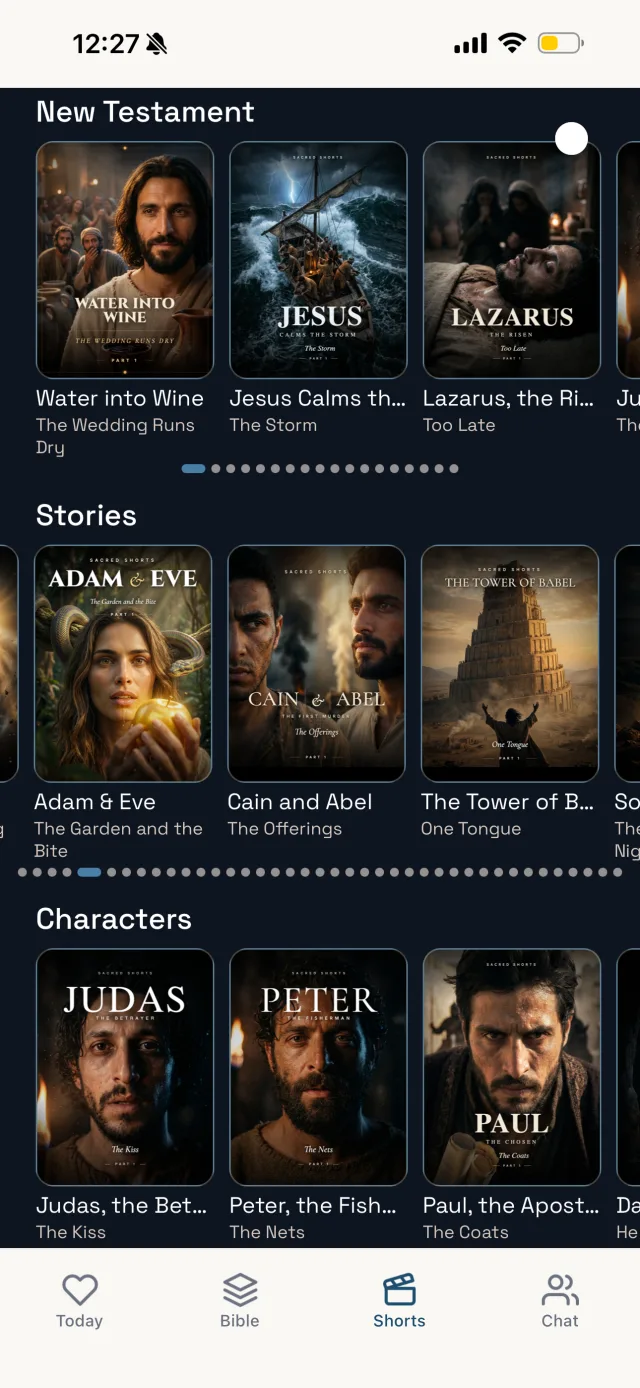
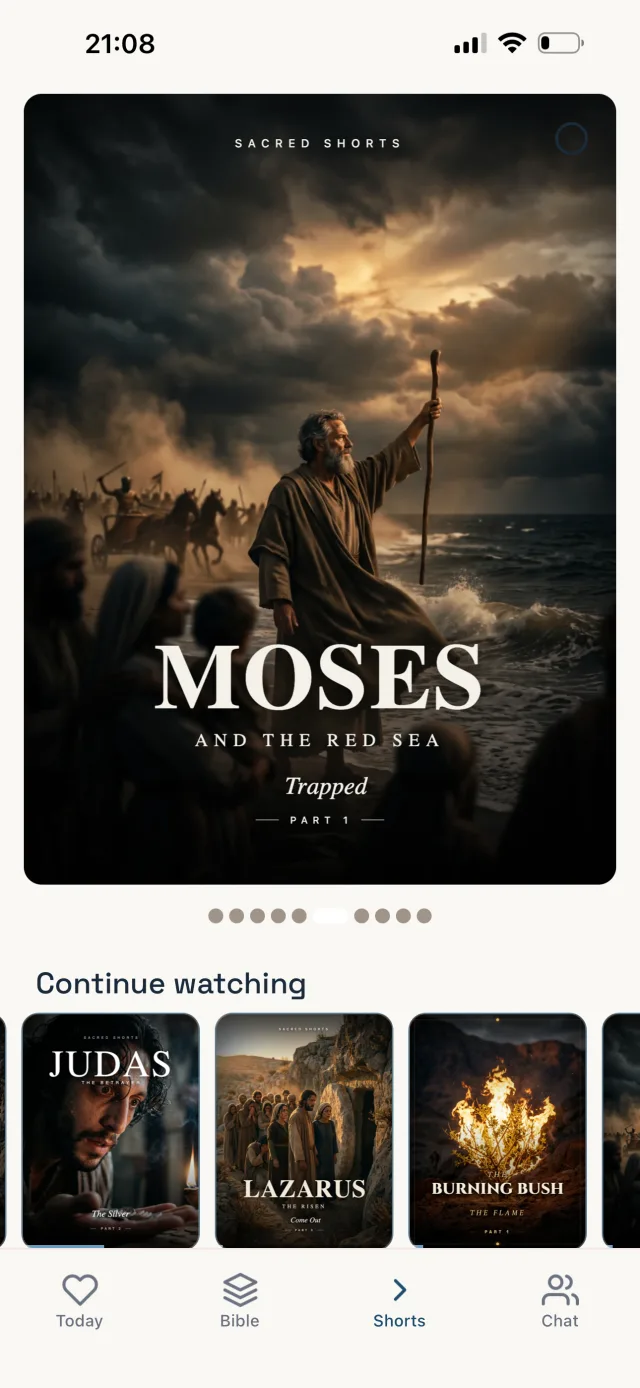
Tweens start noticing when content talks down to them. Two formats meet them where they are. BibleProject's animated videos explain whole books and themes of the Bible in five to ten minutes, with visual density that rewards a curious mind. Sacred Shorts takes the other lane: cinematic Bible-story series in vertical episodes of a few minutes each, including Moses and the Red Sea, Cain & Abel, The Burning Bush, and Creation, with new series added weekly. The short episodes match how tweens already consume video, and the app is available on iOS and Android (subscription); parents will want to watch alongside, since the storytelling is cinematic rather than cartoon-cute. For teens ready to graduate further, the live-action options in our guide to the best Bible story videos are the next step.

The Bible has never felt like this
Watch this story come to life as a cinematic series in Sacred.
4.8on the App Store
Which Bible stories should kids see first?
Start with stories that have strong pictures, clear stakes, and a good ending. Creation and the garden. Noah's ark. Moses and the crossing of the Red Sea. David and Goliath. Jonah. The birth of Jesus. Save the heavier narratives, like the crucifixion or the plagues, for when a child is old enough to ask about them, and answer honestly when they do.
What about the harder stories? Kids will eventually ask about Cain and Abel, the crucifixion, or the flood's darker side, and that is healthy. The rule of thumb: do not lead with the heavy material, but never lie about it when it comes up. A nine-year-old who asks why God sent the flood deserves a real answer at nine-year-old depth, and the conversation will do more for their faith than the cartoon did. Animated treatments actually help here, because animation can show the weight of an event without live-action graphicness.
There is a biblical logic to starting early. Paul reminds Timothy of his own childhood formation:
"...from infancy you have known the Holy Scriptures, which are able to make you wise for salvation through faith in Christ Jesus." — 2 Timothy 3:15 (NIV)
"From infancy" is not an exaggeration. Kids absorb these stories years before they can articulate them, and the stories are still there decades later. The full Bible Stories archive is a good source for the passages behind whatever your kids watch.
How do you watch with kids instead of just handing over the screen?
The difference between a cartoon that entertains and a cartoon that forms is a parent in the room. Four small habits do the work.
Watch it with them, at least the first time. Your presence signals that this story matters more than the average cartoon.
Ask one question afterward. Not a quiz. Try "What was your favorite part?" or "Why do you think God did that?" Then actually listen.
Open the real Bible. Even three verses. A child who sees the story come out of a physical book learns that the cartoon was pointing at something real.
Let them retell it. To a sibling, a grandparent, a stuffed animal. Retelling is memory glue, and it is the pattern Scripture itself commands:
"Impress them on your children. Talk about them when you sit at home and when you walk along the road, when you lie down and when you get up." — Deuteronomy 6:7 (NIV)
For more ways to build watching into your family rhythm, including options for teens and adults in the same house, see our guide to Christian videos the whole family will enjoy.
How much screen time should Bible cartoons get?
Bible content is still screen time, and wise parents count it as such. A useful frame: Bible cartoons earn their minutes not by being on a screen but by what happens off the screen afterward. One episode followed by a conversation and a few verses beats three episodes in a row every single time.
Practically, that means favoring stopping points over bingeing. Series with clear episode boundaries, or short-form episodes of a few minutes, make it easy to say "one more and then we read it in the real Bible" and actually keep that promise. It also means keeping the best stories for shared moments rather than solo tablet time; a child who only ever meets Scripture alone on a device learns that faith is private entertainment, which is the opposite of the lesson. Used this way, even a modest fifteen minutes twice a week compounds into something remarkable over a childhood.
A gentle way to start tonight
Pick one story your child already half-knows, maybe Noah or David, and one option from the table above that fits their age. Watch it together tonight, ask one question, and read a few verses of the real passage before bed. Do that twice a week for a month. You will be surprised how quickly "can we watch another one?" turns into "can you read me the real one?", which is exactly the trade you were hoping to make.
 Sacred Shorts
Watch the Bible like never before
Cinematic Bible stories, a complete Study Bible, daily devotionals, and guided prayer. New episodes every week.
Frequently asked questions
For most families, Superbook is the strongest all-around pick for ages five to ten, with polished animation and a clear takeaway in every episode. BibleProject works better for kids nine and up, and The Prince of Egypt is the best animated feature film for a family night.
Around ages two to four, kids can enjoy short, gentle Bible content in small doses with a parent present. Full episode-length series like Superbook land best from about age five, when children can follow a complete story arc.
Good ones stay faithful to the events while simplifying language and adding visuals kids can follow. Expect compression and invented framing characters, and treat any cartoon as a doorway: read the real passage together afterward so kids meet the actual text.
Yes. Superbook episodes stream free on its app and website, and BibleProject is free on YouTube. Sacred Shorts is a subscription app on iOS and Android, and The Prince of Egypt usually requires a rental or streaming subscription.