If your last waking minutes belong to an anxious scroll, calming Bible story videos offer a different ending to the day: slow-paced, familiar stories of God's faithfulness that settle the mind instead of stirring it. Paired with a few quiet verses and a simple routine, they can turn bedtime from the most restless part of your day into the most peaceful. Here is what to watch, which passages to keep at your bedside, and a practical wind-down routine you can start tonight.
Quick answer: key takeaways
- What you consume in the last 30 minutes before sleep sets the tone your mind carries into the night.
- Choose slow, familiar Bible stories and gentle Scripture readings, not suspenseful or fast-cut content.
- Anchor verses: Psalm 4:8 ("In peace I will lie down and sleep") and Philippians 4:6-7 (the peace that guards hearts and minds).
- Good options include short cinematic story episodes, LUMO's word-for-word Gospel films, and Scripture-with-music readings.
- A four-step wind-down, dim → watch → pray → rest, takes about 20 minutes.
Why do Bible stories help you wind down?
Sleep struggles are often thought struggles. You lie down and the mind replays the day, rehearses tomorrow, and inflates every worry the dark makes larger. Whatever you feed your attention in the last half hour before bed either fuels that spiral or interrupts it. A news feed fuels it. A familiar story of God parting a sea or keeping a promise interrupts it, because it moves your attention from your circumstances to God's character.
This is not a modern relaxation hack; it is the Bible's own bedtime posture:
"In peace I will lie down and sleep, for you alone, Lord, make me dwell in safety." — Psalm 4:8 (NIV)
David wrote that line while surrounded by real trouble, not after solving it. The peace came from remembering who was keeping watch, and that is precisely what a calm retelling of Scripture does for a tired mind: it re-narrates the night. You stop being the one holding everything together and become, again, someone held.
Familiar stories carry a second gift at bedtime: they ask nothing of you. There is no plot to track, no outcome in doubt, no decision to make. The ark lands. The sea parts. The promise holds. For a mind that has spent all day deciding things, resting inside a story whose ending is already secure is a kind of Sabbath in miniature, and it is a far gentler final input than a feed engineered to keep you scrolling.
What makes a Bible video calming?
Not every Bible video suits bedtime; some are made to wake you up. For sleep, look for four qualities:
- Slow pace. Long shots and unhurried storytelling, not rapid cuts. Cinematic story episodes work; highlight reels do not.
- Familiar stories. Novelty keeps the brain alert. The hundredth telling of Noah or the creation of the world soothes precisely because you know where it is going.
- Gentle audio. Soft narration and quiet music. If a video has a dramatic score built for adrenaline, save it for daytime.
- A resolved ending. End the night inside stories of God's faithfulness, creation, provision, rescue, rather than mid-crisis. A story like Noah and the Flood ends in covenant and rainbow, which is exactly the note to sleep on.
One honest caution about screens: brightness and unpredictability, more than screens themselves, are what keep people wired. Lower the brightness, keep the volume soft, and consider watching early in your routine, then letting audio or silence carry you the rest of the way.

The Bible has never felt like this
Watch this story come to life as a cinematic series in Sacred.
4.8on the App Store
Calming Bible videos and audio to try
These established options each fit a different spot in a nighttime routine:
| Option | Format and length | Why it works at night | Cost |
|---|---|---|---|
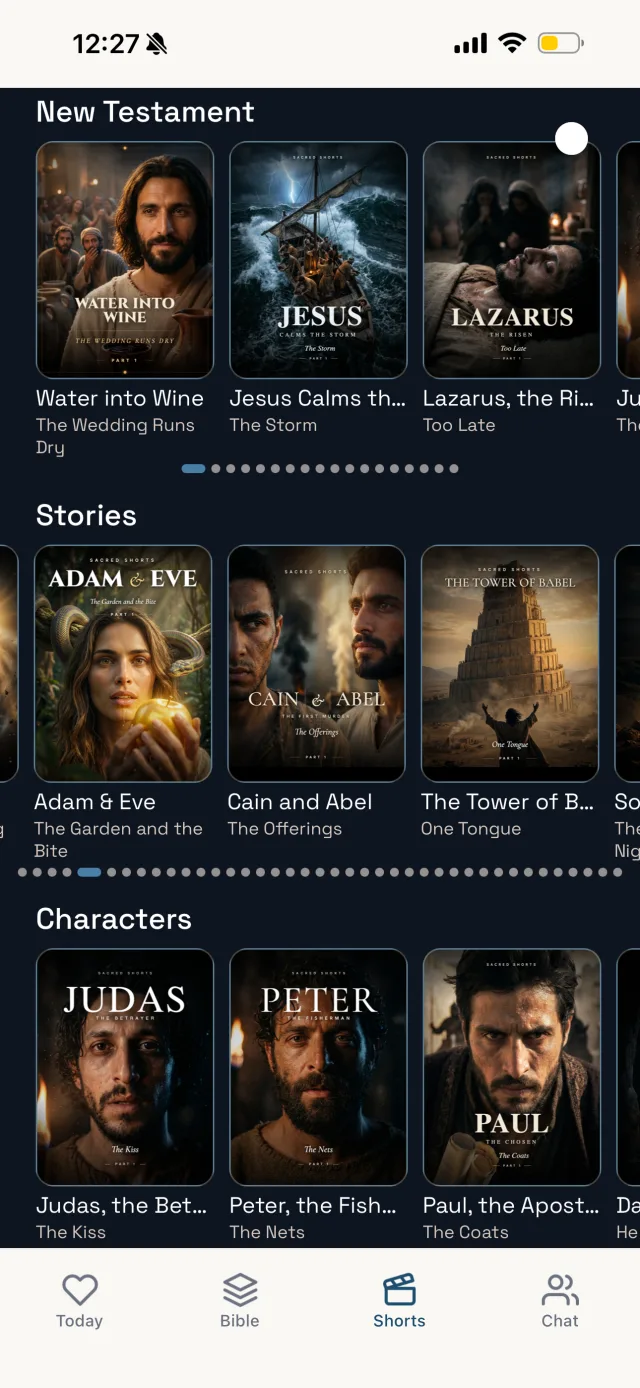
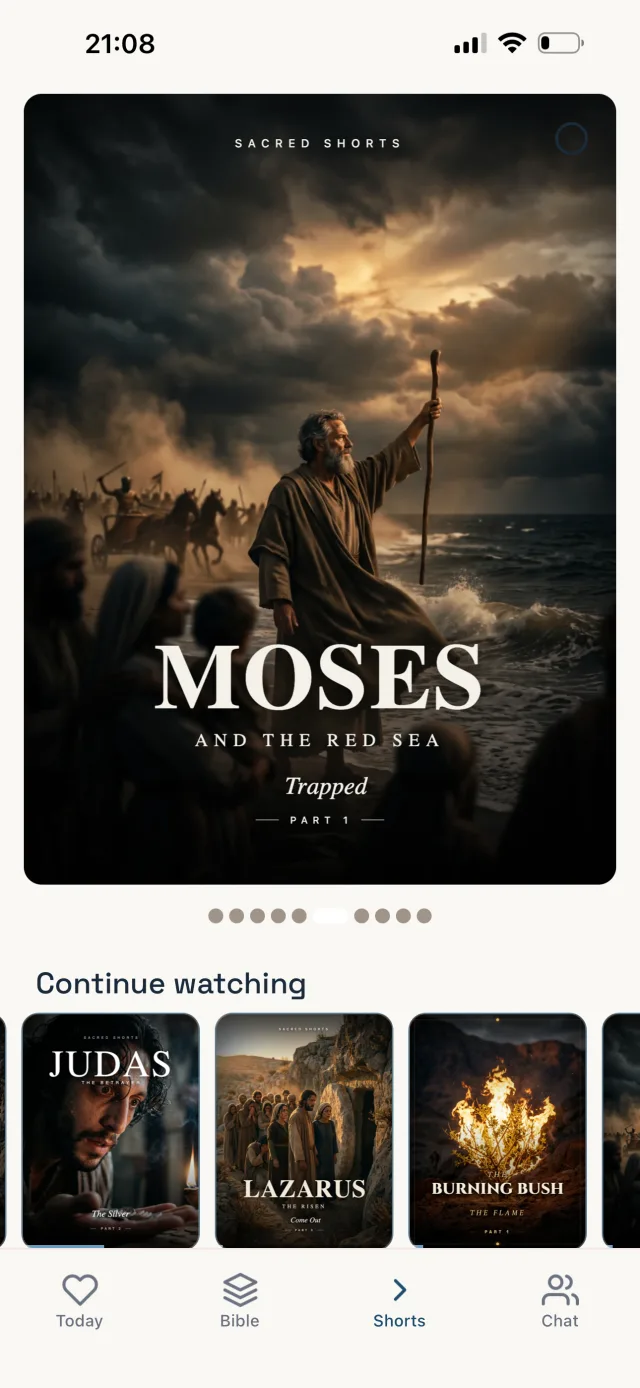
| Sacred Shorts (Sacred app) | Cinematic Bible-story episodes, a few minutes each | Short, story-complete episodes (Creation, Noah-adjacent stories, The Burning Bush, Moses and the Red Sea) you can finish before your eyes get heavy; new series weekly | Free app (iOS & Android) |
| LUMO Project | Word-for-word Gospel films | Steady narration of the Gospel text itself, easy to drift with | Free to stream |
| BibleProject | Animated explainers, 5–10 minutes | Calm narration and gentle visuals for reflective viewing | Free on YouTube |
| Scripture readings with music | Audio or video, 20 minutes to 8 hours | Psalms read slowly over ambient music, made for eyes-closed listening | Free on YouTube and podcast apps |
| The Chosen | Series episodes, ~50 minutes | Better for evening viewing than final wind-down; episodes are long and emotionally engaging | Free to stream |
The Sacred app pairs its episodes with a full Bible reader and daily devotionals, so the verse you fall asleep to can be the one you wake up with. If evenings are simply the only margin your schedule allows for Scripture, this guide to short Bible videos for busy people shows how to build on that single anchor.
A practical Scripture wind-down routine
Here is a simple four-step routine that takes about 20 minutes. The order matters: each step hands you off to the next, ending in the dark with your mind already resting somewhere good.
- Dim (5 minutes). Lights low, phone on night mode, notifications silenced. Put tomorrow's one scariest task on paper so your brain can stop holding it.
- Watch (5–10 minutes). One calm story episode, brightness down, volume soft. Choose the story before you pick up the phone so the feed never gets a vote.
- Pray (3–5 minutes). Trade every remaining worry for a request, one by one, with thanks attached. This step is straight from Scripture's own anxiety protocol:
"Do not be anxious about anything, but in every situation, by prayer and petition, with thanksgiving, present your requests to God. And the peace of God, which transcends all understanding, will guard your hearts and your minds in Christ Jesus." — Philippians 4:6-7 (NIV)
- Rest (however long it takes). Screen off and away. Repeat one verse slowly in the dark, Psalm 4:8 is made for this, and let it be the last sentence of your day.
If you fall asleep during step two or three, that is not failure. A child who drifts off mid-story in a parent's arms has not disrespected the story.
Two small adjustments make the routine stick. Keep the phone out of reach once step four begins, ideally charging across the room, so a wakeful moment at 2 a.m. reaches for a verse instead of a screen. And run the same routine at roughly the same time each night; peace, like sleep itself, responds well to rhythm.
Which Bible passages are best before sleep?
Keep a short rotation so the words become worn smooth with use:
- Psalm 4:8, the lie-down-in-peace verse quoted above, brief enough to repeat until sleep comes.
- Psalm 23, the shepherd psalm: green pastures, quiet waters, a table prepared.
- Psalm 91, shelter and refuge under God's wings, a favorite for anxious nights.
- Philippians 4:6-7, the exchange of anxiety for prayer and guarded peace.
- Matthew 11:28, "Come to me, all you who are weary and burdened, and I will give you rest," six words from Jesus that carry a whole night's theology: rest is received, not achieved.
Rotate rather than collect: one verse per week, repeated nightly, will serve you better than a new one every evening. By the end of a season you will own a small anthology of peace by heart, available on any sleepless night without reaching for a light.
For the stories behind the verses, the Bible Stories collection is a good place to wander, and for daytime rhythms that complement this nighttime one, browse the Christian Living collection.
Your next step: redesign tonight's last 20 minutes
Do not overhaul your evenings; just claim tonight. Choose one calm story episode now, before bedtime decides for you, and walk the four steps: dim, watch, pray, rest. Try it for one week and pay attention to what your mind reaches for when the lights go out. Most people find that the anxious replay gets quieter, not because their problems shrank overnight, but because the last voice they heard before sleep was telling a better story.
 Sacred Shorts
Watch the Bible like never before
Cinematic Bible stories, a complete Study Bible, daily devotionals, and guided prayer. New episodes every week.
Frequently asked questions
Yes. Slow-paced Bible story episodes, word-for-word Gospel films like the LUMO Project, and Scripture readings with gentle music all work well at bedtime. The key is choosing calm, familiar content with a steady pace rather than anything suspenseful or brightly edited.
Psalm 4:8 is the classic bedtime verse: 'In peace I will lie down and sleep, for you alone, Lord, make me dwell in safety.' Philippians 4:6-7 is equally loved at night because it trades anxiety for prayer and promises the peace of God will guard your heart and mind.
Yes. Falling asleep during Scripture is not disrespect; it is trust, like a child drifting off mid-story in a father's arms. Ending the day inside God's story shapes what your mind settles on, which matters more than staying awake to the end.
Bright, fast, unpredictable content is the real problem, because it keeps your brain alert. If you watch at night, lower the brightness, use night mode, keep the volume soft, and choose slow, familiar stories. Many people watch a short episode early in the routine, then finish with audio or silence.