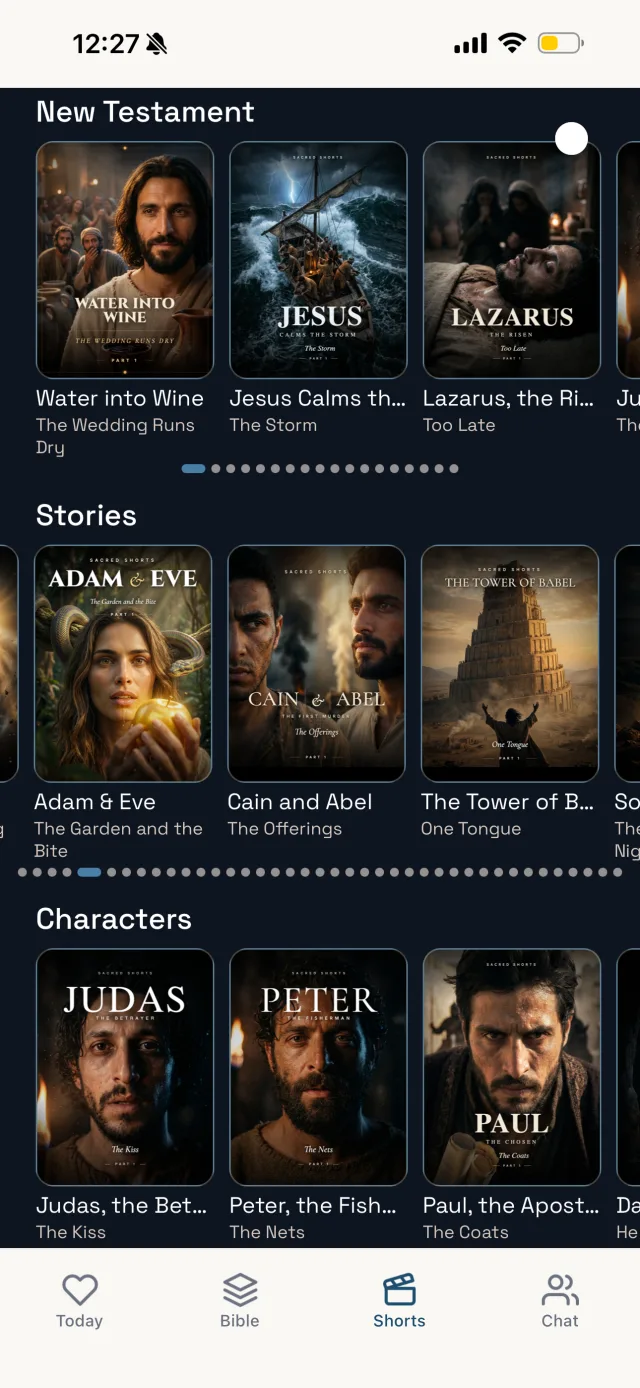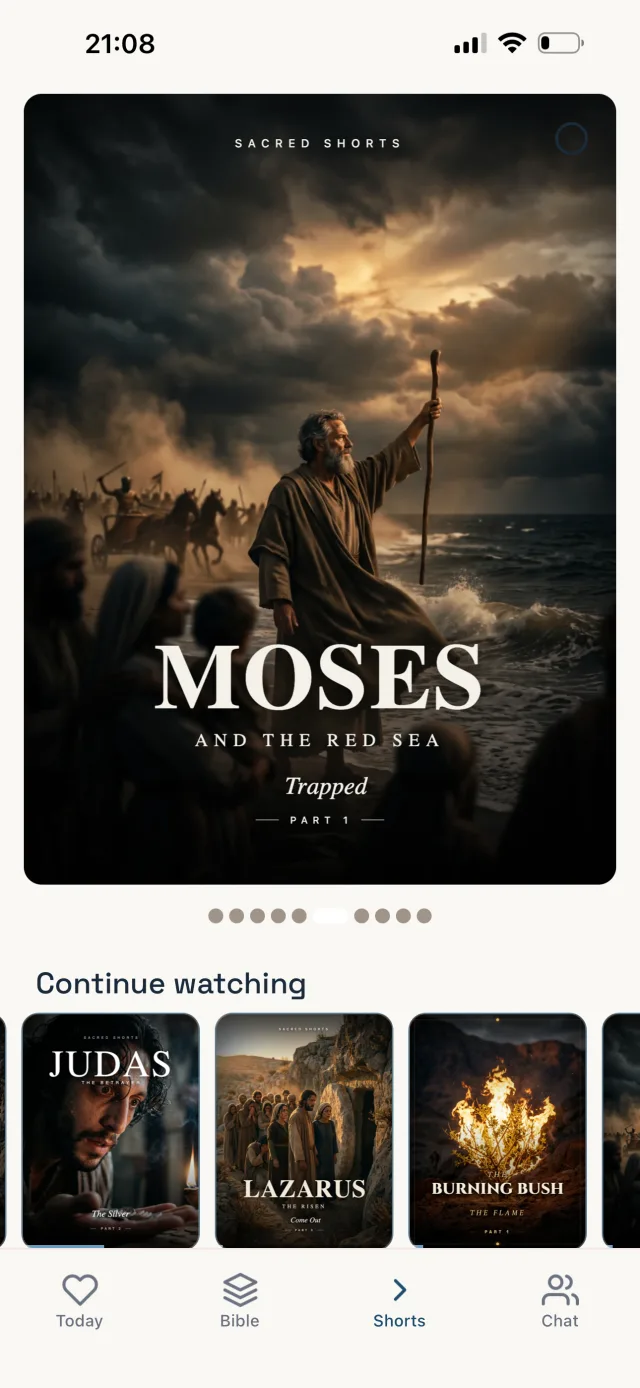
The Ten Commandments story is one of the most memorable scenes in the Bible: a rescued people gathered at the foot of a mountain, thunder and cloud over Sinai, Moses ascending to meet God, and words of covenant given to shape Israel's life with the Lord. A Ten Commandments story video can help modern viewers feel the scale of the moment. It can show the wilderness silence after Egypt, the trembling of the people, the distance between the holy mountain and the camp, and the seriousness of receiving God's words.
But the video is a doorway, not the destination. It helps us imagine and enter the biblical story, but it does not replace Scripture. The Ten Commandments are given in Exodus 20 and repeated in Deuteronomy 5, with surrounding context that matters deeply. Every visual adaptation has to choose what to show, how to pace the scene, and how to portray awe without turning holiness into spectacle. Scripture remains the inspired text; video should lead us back to reading, reflection, and prayer.
Where the Ten Commandments fit in Exodus
The commandments do not appear in isolation. They come after God has already delivered Israel from slavery in Egypt. Exodus begins with oppression, cries for mercy, the call of Moses, the confrontation with Pharaoh, the Passover, and the crossing of the sea. By the time Israel reaches Sinai, the people are not trying to earn rescue. They have already been rescued by God's power and mercy.
That order matters. Exodus 20 begins, "I am the LORD your God, who brought you out of the land of Egypt, out of the house of slavery." The commandments flow from covenant relationship. They show what life with the rescuing God should look like: worship without rivals, reverence for God's name, holy rest, honor in family life, and justice toward neighbors. A faithful video should not present Sinai as random rule-giving from a distant deity. It should show that God's law is given to a people he has drawn near.
The surrounding chapters also show the seriousness of holiness. Israel prepares before approaching the mountain. Boundaries are set. Moses goes up and down as mediator. The people hear thunder, trumpet, and the voice of God, and they are afraid. The scene is not casual. It teaches that the Lord who saves is also holy, and that covenant life involves response, obedience, worship, and trust.
Why Sinai works on screen
Sinai is intensely visual. A film can contrast the dust of the wilderness with the darkness of the cloud, the smallness of the camp with the height of the mountain, and the people's fear with Moses' obedience. It can help viewers sense that the commandments are not abstract ideas floating above history. They are spoken into a particular story: former slaves learning to live as God's covenant people.
A video can also slow down details we often skim. The first commandments concern worship: no other gods, no idols, no misuse of God's name, and the Sabbath. Then the commandments move outward into human relationships: honor, life, marriage faithfulness, property, truth, and desire. The order invites reflection. Love for God and love for neighbor are not separate worlds. Jesus later summarizes the law with those two great commands, and Christian readers often understand the Ten Commandments through that wider biblical lens.
Still, every camera angle interprets. Does the video emphasize fear, mercy, wonder, law, covenant, or rebellion? Does it make Moses look heroic in a way that hides his role as servant and mediator? Does it rush past the opening line about deliverance? After watching, the healthiest next step is to open Exodus 19-20 and Deuteronomy 5. Ask what the scene helped you notice, what it added for dramatic clarity, and what the biblical text emphasizes most.

The Bible has never felt like this
Watch this story come to life as a cinematic series in Sacred.
4.8on the App Store
Law, grace, and denominational care
Christians share a deep respect for the Ten Commandments, but traditions may number them slightly differently and may explain Sabbath practice, images, and the law's relation to Christian life with different emphases. Catholic, Orthodox, Protestant, and other Christian communities often agree on the moral seriousness of God's commands while organizing or applying some details differently. A thoughtful video should avoid acting as if one presentation exhausts the whole Christian tradition.
The larger biblical story also guards us from two mistakes. One mistake is legalism: treating obedience as a way to make God owe us acceptance. In Exodus, God's saving action comes first. Another mistake is dismissal: acting as if God's commands are unimportant because grace is real. Scripture does not present grace and holiness as enemies. God's mercy forms a people who are called to worship him and love their neighbors truthfully.
This is why the Ten Commandments remain powerful for reflection. They confront visible sins and hidden desires. They ask whether worship has rivals, whether speech honors God's name, whether rest is received as gift, whether parents and neighbors are treated with dignity, whether truth is guarded, and whether desire has become a form of grasping. A video can make Sinai feel near, but the text and the Spirit-shaped work of reflection bring the questions home.
Watch, read, reflect, pray
A simple rhythm for using a Ten Commandments video is watch, read, reflect, pray. First, watch the scene with attention. Notice what it stirs: awe, fear, resistance, gratitude, curiosity, or conviction. Let the visuals help you imagine the people gathered below the mountain, hearing God's words after years of bondage.
Second, read the passage. Begin with Exodus 19 to see the preparation, then read Exodus 20 slowly. If you have time, compare Deuteronomy 5, where Moses retells the commandments to a new generation. Notice the opening statement of deliverance. Notice how worship and neighbor-love belong together. Notice that the commandments are not merely private spirituality; they shape a whole community.
Third, reflect with honesty. Which commandment do you tend to reduce to an obvious external rule? Which one exposes something deeper in your loves, speech, rest, habits, or relationships? Where do you need to receive God's grace rather than hide behind performance? Where do you need obedience that is concrete and ordinary?
Fourth, pray. You might pray the commandments back to God: asking for undivided worship, reverent speech, peaceful rest, honor in family life, protection for life, faithfulness, integrity, truth, and contentment. Prayer keeps the video from becoming religious entertainment. It turns the scene into response before the Lord.
Continuing with Sacred
Sacred is built for that rhythm. Sacred Shorts can help you see a biblical scene with cinematic attention. The Study Bible helps you return to the passage. Devotionals invite reflection for daily life. Guided prayer helps you respond personally. AI Bible Chat can support thoughtful questions about context, language, and meaning while keeping Scripture at the center.
If you watch the Ten Commandments story today, do not stop at the mountain image. Open Exodus. Read the words. Reflect on the God who rescues and commands. Then pray for a life shaped by worship, mercy, truth, and love. Video can help you enter the story; Scripture is where the story speaks with authority.
FAQ
Where are the Ten Commandments found in the Bible?
The Ten Commandments are given in Exodus 20 and repeated in Deuteronomy 5. Exodus 19 is also important because it shows Israel preparing to meet God at Mount Sinai before the commandments are spoken.
Can a Ten Commandments story video replace reading Exodus?
No. A video can help you imagine the mountain, the people, and the seriousness of the covenant moment, but it should not replace Scripture. The best pattern is watch, read, reflect, and pray.
Why do some Christian traditions list the commandments differently?
Different Christian traditions group parts of Exodus 20 and Deuteronomy 5 in slightly different ways, especially around images and coveting. The underlying biblical text is the same, and readers should consult their tradition while returning carefully to Scripture.
 Sacred Shorts
Watch the Bible like never before
Cinematic Bible stories, a complete Study Bible, daily devotionals, and guided prayer. New episodes every week.