If you want to watch the story of Cain and Abel in video, the most complete dramatization available today is the Cain & Abel series on Sacred Shorts, which tells Genesis 4 as a cinematic short-form series; BibleProject's free Genesis overview covers it in context. The story itself is the Bible's first tragedy: two brothers, two offerings, one murder, and a question that still echoes, "Am I my brother's keeper?"
Quick answer: key takeaways
- Cain and Abel is told in Genesis 4:1-16, directly after the fall of Adam and Eve.
- It is the first murder in the Bible, and the first story about sin between people.
- Sacred Shorts has a dedicated Cain & Abel cinematic series in short vertical episodes, free on iOS and Android.
- BibleProject's Genesis 1-11 overview is the best free explainer of the story's context.
- On screen, the story plays as an intimate four-character tragedy, closer to a stage drama than an epic.
The story of Cain and Abel, scene by scene
Genesis 4 is only sixteen verses long, but it has the full structure of a tragedy. Here is how it unfolds, episode by episode.
Episode 1: The first family
Outside Eden, Adam and Eve begin again. Eve gives birth to Cain, then Abel. The brothers grow into different vocations: Cain works the soil, like his father was condemned to do, and Abel keeps flocks. Nothing in the text suggests rivalry yet; it is an ordinary family building a life after catastrophe. If you have not read what came just before, our study of the fall of Adam and Eve sets the stage: this family already knows what disobedience costs.
Episode 2: Two offerings
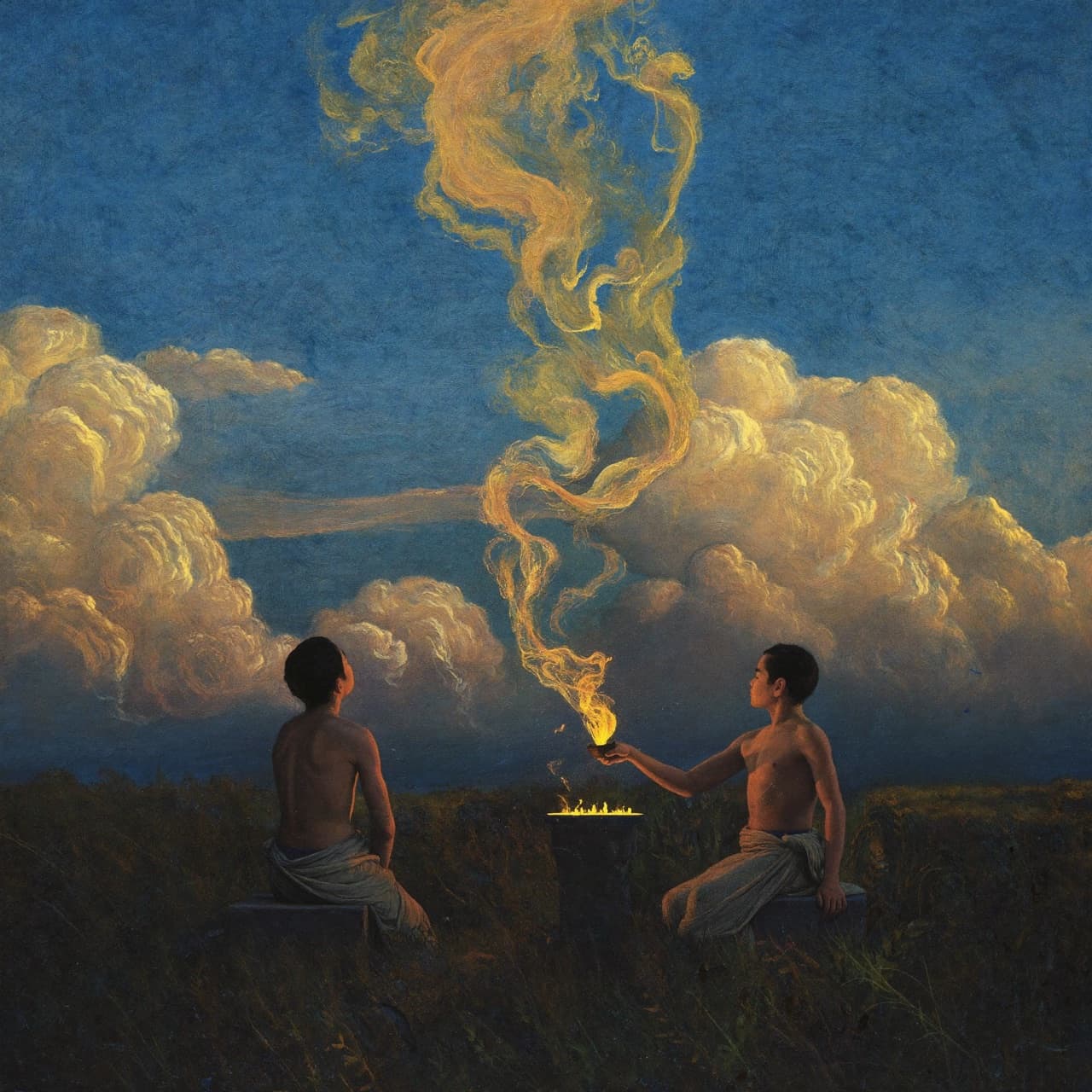
In the course of time, both brothers bring offerings to God. Cain brings some of the fruits of the soil; Abel brings fat portions from the firstborn of his flock. God looks with favor on Abel and his offering, but not on Cain and his. The text is spare here on purpose, but it names the giver before the gift both times: the issue is the heart, not the produce. Cain's face falls, and the story's engine starts turning.
Episode 3: The warning at the door
This is the scene most retellings skip, and it is the most important one. God comes to Cain not with condemnation but with a warning and a choice:
"Then the Lord said to Cain, 'Why are you angry? Why is your face downcast? If you do what is right, will you not be accepted? But if you do not do what is right, sin is crouching at your door; it desires to have you, but you must rule over it.'" — Genesis 4:6-7 (NIV)
Sin pictured as a predator crouching at the door is one of the most vivid images in Genesis. Cain hears the warning. He says nothing back.
Episode 4: The field
Cain invites his brother out to the field. Away from their parents, away from witnesses, Cain attacks Abel and kills him. The Bible gives the murder one verse, no slow motion, no dramatics. The restraint is the horror.
Episode 5: The question
God asks Cain where his brother is, an echo of "Where are you?" asked of Adam one chapter earlier. Cain's reply is the first recorded lie to God's face and one of the most quoted lines in Scripture:
"Then the Lord said to Cain, 'Where is your brother Abel?' 'I don't know,' he replied. 'Am I my brother's keeper?'" — Genesis 4:9 (NIV)
God answers that Abel's blood cries out from the ground. Cain is sentenced to wander, the ground itself now closed to him. Yet even here there is mercy: God marks Cain so that no one will kill him, protection wrapped inside punishment (Genesis 4:15).

The Bible has never felt like this
Watch this story come to life as a cinematic series in Sacred.
4.8on the App Store
Why does Cain and Abel work so well on screen?
Most Bible epics live on scale: seas parting, plagues falling, armies clashing. Cain and Abel is the opposite, and that is exactly its power on screen.
It is a chamber drama. Four characters, two locations, one act of violence. Everything happens in faces: Cain's falling countenance, the sideways glance at a brother whose offering was accepted, the moment in the field before it happens. This is the kind of story close-up cinematography was made for, which is why it translates so naturally to short-form vertical video, where the camera lives close to the actor's face.
The audience knows the psychology. Almost nobody watching has parted a sea. Everybody watching has felt overlooked while someone else was praised, and felt something ugly stir. The story reads the viewer as much as the viewer reads the story.
The tension is moral, not physical. The suspense is not whether Cain is strong enough, but whether he will master the thing crouching at his door. God's warning in Genesis 4:7 turns the whole story into a hinge: for one scene, the first murder is still preventable. Good adaptations sit in that pause, and it makes the murder land harder than any battle sequence. It is a story built for adult viewers, which is why we highlight it in our roundup of Bible videos made for adults.
Where can you watch Cain and Abel in video?
| Option | Format | Length | Best for | Cost |
|---|---|---|---|---|
| Sacred Shorts: Cain & Abel series | Cinematic vertical series | A few minutes per episode | The full story, dramatized for your phone | Free app (iOS and Android) |
| BibleProject: Genesis 1-11 overview | Animated explainer | ~8 min | Understanding the story's place in Genesis | Free (YouTube) |
| Bible TV miniseries (various) | Live-action epic episodes | Scene within longer episodes | Seeing it inside the larger biblical sweep | Streaming, varies |
| Superbook | Animated kids' episodes | ~25 min | Introducing themes to children gently | Free on Superbook's platforms |
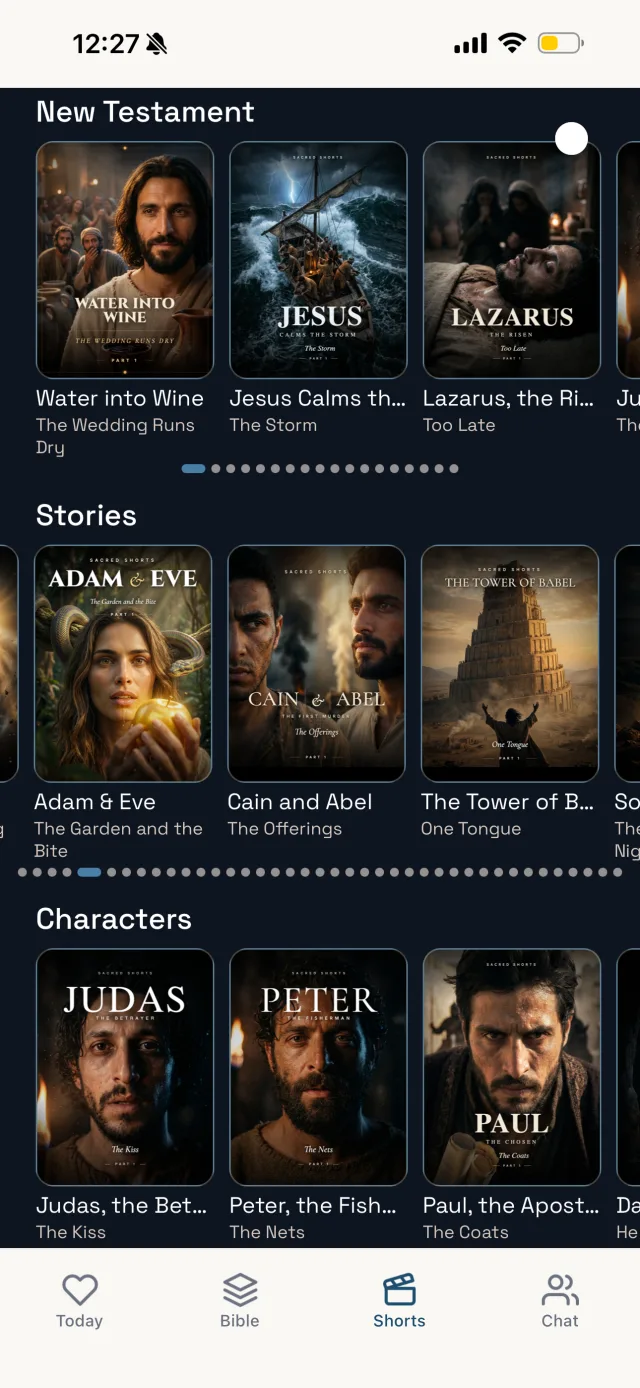
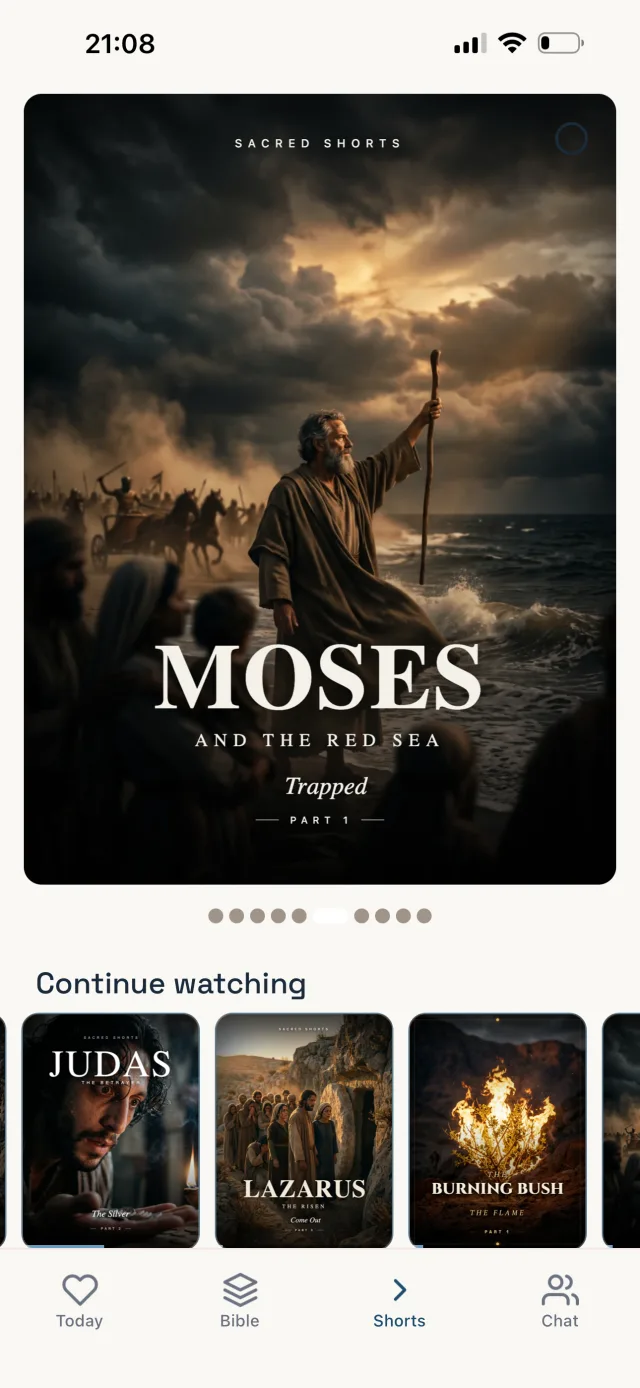
Sacred Shorts is the one option built specifically around this story: a dedicated Cain & Abel series told in short cinematic episodes, part of a growing catalog that also includes Creation, Adam & Eve, and Moses and the Red Sea, with new series added weekly. The app is free on iOS and Android, rated 4.8 stars on the App Store, and available in English, Spanish, and Portuguese. Because the app also includes a full Bible reader and an AI-powered Bible Chat, you can watch an episode, read Genesis 4 in the translation you prefer, and ask the questions the story raises, all in one place. If your margin for watching is five minutes in a waiting room, this format was designed for you; see our guide to short Bible videos for busy people.
What the story asks of you
Cain and Abel endures because it refuses to stay ancient. Its two questions are permanently current. The first is God's: "Why are you angry?" — an invitation to examine envy before it matures into something worse. The second is Cain's: "Am I my brother's keeper?" — which the rest of the Bible spends sixty-five books answering with yes.
Watching the story dramatized makes those questions harder to dodge, because you see yourself in Cain's face before the field, in the moment when doing right was still possible. Sin crouching at the door is not a Bronze Age problem; it is a Tuesday problem.
The rest of the Bible refuses to let Abel go, too. Hebrews 11:4 names him the first hero of faith, whose offering "still speaks, even though he is dead," and Jesus himself calls him "righteous Abel" (Matthew 23:35). The New Testament even circles back to the blood in the ground: Hebrews 12:24 says the blood of Jesus "speaks a better word than the blood of Abel," a cry for mercy answering a cry for justice. A four-thousand-year-old field, and Scripture treats it as unfinished business until the cross.
After you watch: a simple next step
Read Genesis 4:1-16 yourself; it takes three minutes. Then sit with one question: where is your countenance falling right now, and what would "doing what is right" look like there this week? If the story hooks you, keep following the thread of Genesis, from creation through the flood, where the violence Cain started spreads to a whole world. The Bible's opening chapters are a connected saga, and there are many more Bible stories worth watching and reading in order.
 Sacred Shorts
Watch the Bible like never before
Cinematic Bible stories, a complete Study Bible, daily devotionals, and guided prayer. New episodes every week.
Frequently asked questions
Sacred Shorts has a dedicated Cain & Abel cinematic series told in short vertical episodes, free on iOS and Android. BibleProject's Genesis 1-11 overview also covers the story in context, and most multi-part Bible TV productions include the scene briefly.
The story is told in Genesis 4:1-16, immediately after Adam and Eve are exiled from Eden. It is the Bible's first account of sin between humans, following the first sin against God in Genesis 3.
Genesis says God looked with favor on Abel and his offering but not on Cain and his, and points to the heart behind the gift: Abel brought the firstborn of his flock, while Hebrews 11:4 says Abel offered his sacrifice by faith. God's warning in Genesis 4:7 shows the door was still open for Cain to do right.
After the murder, God sentences Cain to wander but places a mark on him so no one who finds him will kill him (Genesis 4:15). The Bible never describes what the mark looked like; it functions as an act of protective mercy inside a judgment.