The Old Testament can feel vast when you are deciding where to begin. It opens with creation, moves through families and covenants, follows Israel out of slavery, gives laws and wisdom, tells the stories of kings and prophets, and ends with longing for restoration. A good Bible video can help you enter that world with your imagination awake.
But the order matters. Without context, the Old Testament can feel like scattered heroic moments instead of one unfolding story. The best first videos help you understand the big movements of Scripture: creation, covenant, rescue, worship, wisdom, exile, and hope.
Video helps us imagine and enter the biblical story, but it does not replace Scripture. Every scene is an interpretation. Costumes, faces, pacing, music, and camera angles make choices that the text itself may leave open. Use video as a doorway, then return to the Bible as the foundation. A simple rhythm works well: watch, read, reflect, pray.
1. Creation and the goodness of the world
Begin with Genesis 1-2. Creation is not just the first scene of the Bible; it gives the whole story its setting. God speaks, orders, blesses, and calls creation good. Humanity is made in the image of God, placed in a garden, and given vocation before sin enters the story. A cinematic retelling can help you feel the wonder of light, land, sea, sky, animals, rest, and human dignity.
After watching, read Genesis 1-2 slowly. Notice repeated words: God saw, God blessed, it was good. Christian traditions sometimes differ on how to read the days of creation, but the core confession is shared: God is Creator, the world belongs to Him, and human life has sacred worth. Let the video awaken wonder, then let the text shape worship.
Reflect with one question: What part of creation helps me remember God's generosity today? Then pray with gratitude rather than rushing into debate.
2. Adam and Eve, the fall, and the ache of sin
Next watch a thoughtful scene from Genesis 3. The story of Adam and Eve is visually powerful because it begins in beauty and moves into distrust, hiding, blame, and exile. The danger with video is to make the scene feel merely like fantasy or moral failure at a distance. Scripture presses deeper: sin distorts trust with God, one another, creation, and ourselves.
Read Genesis 3 after watching. Pay attention to the questions God asks: “Where are you?” and “What is this that you have done?” Those questions are not shallow information requests; they expose the human tendency to hide. Also notice that judgment and mercy appear together. God names consequences, yet also clothes the man and woman.
This is a good place to practice the full rhythm: watch the scene, read the chapter, reflect on where hiding shows up in your own life, and pray honestly. Keep the tone reverent. The point is not to sensationalize shame, but to understand why the rest of Scripture longs for redemption.
3. Abraham and the promise
The story of Abraham is essential because it introduces covenant promise. A first Old Testament playlist should include God's call to Abram in Genesis 12 and the later promise scenes in Genesis 15 and 17. Video can help you feel the vulnerability of leaving home, traveling by faith, looking up at the stars, and waiting for a promise that seems impossible.
Read Genesis 12:1-9 and Genesis 15. Notice that God's promise is not only private comfort for Abraham; through him, all families of the earth will be blessed. That thread moves through Israel and, for Christians, reaches its fullness in Christ. Different traditions may emphasize covenant language in different ways, but the passage itself keeps God's initiative at the center.
A video can give emotional shape to Abraham's waiting, but Scripture gives the covenant its meaning. Reflect on what it means to trust God when fulfillment is not immediate. Pray for faith that listens before every detail is visible.

The Bible has never felt like this
Watch this story come to life as a cinematic series in Sacred.
4.8on the App Store
4. Joseph: providence through suffering
Joseph's story, stretching from Genesis 37 to 50, is one of the most cinematic arcs in the Old Testament. Betrayal, slavery, false accusation, prison, dreams, famine, reunion, and forgiveness all appear. A video can make the emotional movement easier to follow, especially for readers who find long narrative sections difficult.
Watch a Joseph scene, then read a focused passage such as Genesis 37, Genesis 41, or Genesis 45. Do not flatten the story into “everything bad quickly becomes good.” Joseph suffers deeply, and Scripture does not ask us to pretend otherwise. At the same time, the story reveals God's providence working through human evil without calling evil good.
Genesis 50:20 is a key verse: “You meant evil against me, but God meant it for good.” Reflect on the difference between forgiveness and denial. Pray for courage to trust God without rewriting pain as something light.
5. Moses, the Exodus, and the God who rescues
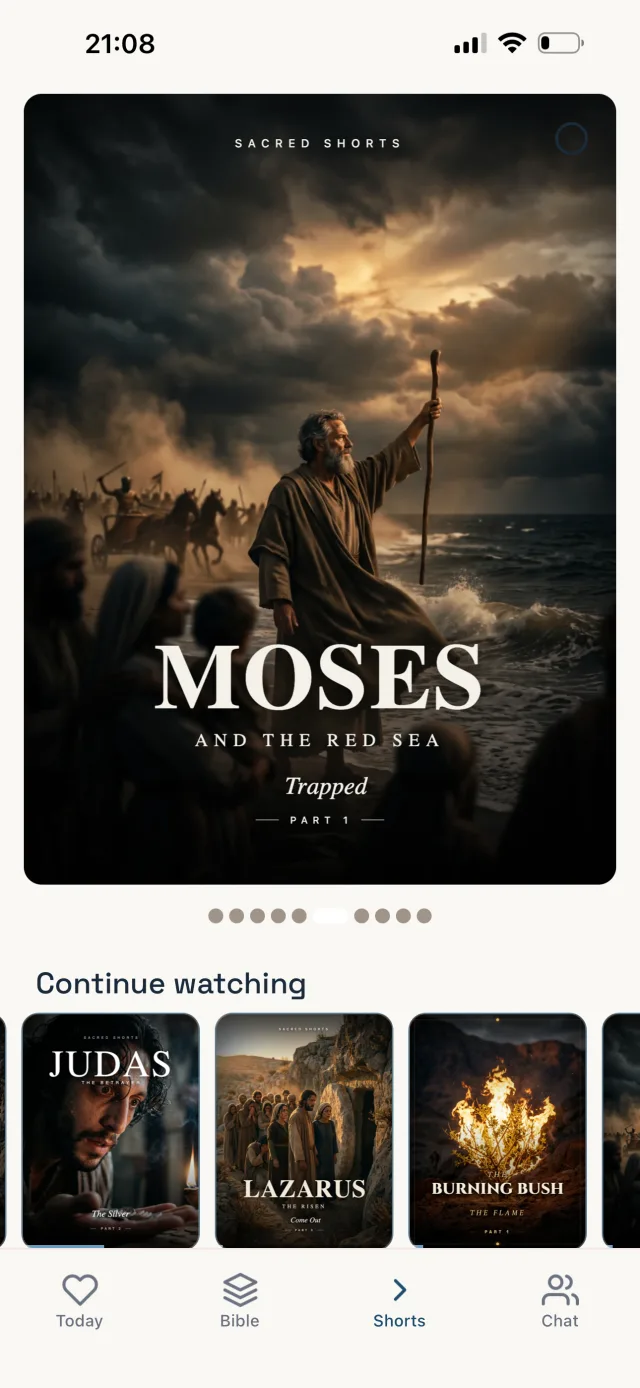
For many people, the Old Testament begins to click when they watch the Exodus story. Moses before Pharaoh, the Passover, the Red Sea, the wilderness, and Mount Sinai form one of Scripture's central rescue narratives. Start with Exodus 1-14, especially the calling of Moses in Exodus 3 and the crossing of the sea in Exodus 14.
Video can help you feel the scale: oppression, fear, plagues, midnight urgency, water, wilderness, and awe. Yet the text keeps the focus on the Lord, not spectacle. Exodus is about God's name, covenant faithfulness, judgment, mercy, and liberation for worship. It is not just an adventure scene.
After watching, read Exodus 3:1-15 or Exodus 14. Ask: What does God reveal about Himself here? Then pray with remembrance. Many Christian traditions also connect Passover imagery to Christ, though they may explain details differently. Keep the biblical text first and let the connections deepen through study.
6. David, kingship, mercy, and worship
David's life offers several strong starting points: David and Goliath in 1 Samuel 17, David sparing Saul in 1 Samuel 24 or 26, David's sin and repentance in 2 Samuel 11-12, and David's prayers in the Psalms. If you choose one first, consider David sparing Saul. It shows courage in a quieter form: mercy when revenge seems possible.
Video often highlights battles, but the Old Testament also gives us conscience, restraint, repentance, and worship. Read 1 Samuel 24 after watching. Notice David's refusal to seize the throne through violence against Saul. He trusts God's timing even when Saul is unjust.
Then pray one of David's Psalms, such as Psalm 23, 51, or 63. This connects story to worship. The Old Testament is not only history to observe; it is Scripture that teaches the heart how to speak to God.
A simple first playlist
If you want a clear order, begin here: Creation, the Fall, Abraham, Joseph, Moses and the Exodus, David, and Elijah. That path gives you the Old Testament's early shape: God creates, humanity falls, God promises, God preserves, God rescues, God forms a people, and God speaks through prophets.
Use each video as the first step, not the final word. Watch to imagine. Read to receive the inspired text. Reflect to notice what God is showing you. Pray to respond with honesty and faith.
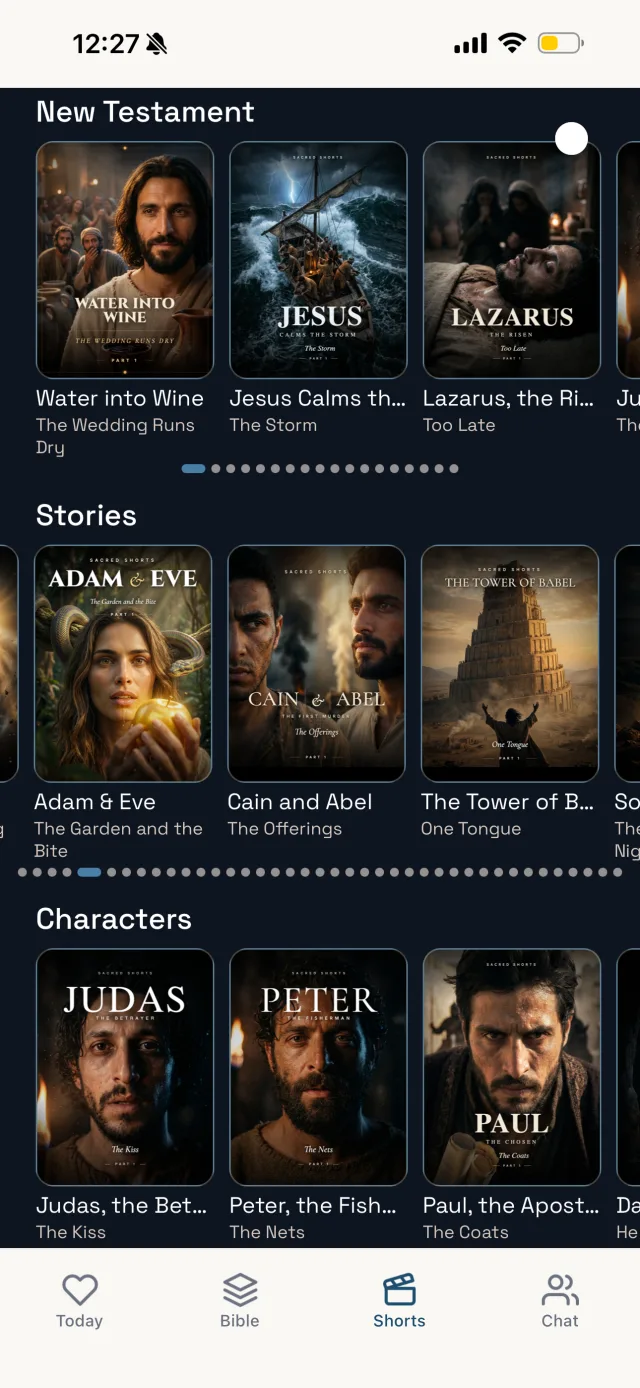
Sacred is built around that rhythm. Sacred Shorts can help you see a biblical scene with fresh attention; the Study Bible keeps Scripture at the center; guided prayer gives you a quiet next step; and AI Bible Chat can help you ask context questions as you keep studying. The goal is not to consume more religious content. The goal is to draw nearer to the Word of God with attention, humility, and hope.
FAQ
What Old Testament Bible video should I watch first?
Start with Creation in Genesis 1-2 or the Exodus in Exodus 1-14. Creation gives the biblical story its foundation, while Exodus shows God's rescue and covenant faithfulness. Either way, read the passage after watching.
Can Bible videos replace reading the Old Testament?
No. Bible videos can help you imagine scenes, remember details, and feel the movement of the story, but they are interpretations. Scripture remains the foundation for study, doctrine, prayer, and worship.
What is the best routine after watching a Bible video?
Use the rhythm watch → read → reflect → pray. Watch the scene, read the biblical passage, reflect on what the text reveals about God and human life, then pray in response.
 Sacred Shorts
Watch the Bible like never before
Cinematic Bible stories, a complete Study Bible, daily devotionals, and guided prayer. New episodes every week.