Daniel was a Jewish exile, a wise servant in foreign courts, a prophet, and a man of disciplined prayer. His story is found in the book of Daniel, during one of the most painful seasons in Israel's history: the Babylonian exile. Jerusalem had fallen, the temple had been devastated, and many young leaders were taken far from home. Daniel's life shows what faithfulness can look like when God's people are living under pressure, surrounded by a culture that does not share their worship.
Who was Daniel?
Daniel was likely a young man from Judah when he was taken to Babylon after King Nebuchadnezzar's conquest. Along with Hananiah, Mishael, and Azariah, he was selected for training in the language, literature, and administration of Babylon. His Hebrew name, Daniel, means something like "God is my judge." In Babylon he was given the name Belteshazzar, a sign that the empire wanted to reshape his identity.
The book of Daniel presents him as intelligent, gifted, and capable of serving with excellence. But his greatness is not merely political or intellectual. Daniel is remembered because he remained faithful to God while serving in environments filled with temptation, pressure, and danger. He refused to compromise his worship, sought wisdom from God, interpreted dreams by God's mercy, and prayed even when prayer became illegal.
The story of Daniel
Daniel's story begins with a quiet act of conviction. In Daniel 1, he resolves not to defile himself with the king's food. The issue was not simply diet; it was loyalty, holiness, and identity in exile. Daniel asks for a faithful alternative, and God gives him favor. This early decision sets the pattern for his life: Daniel does not need to be loud to be courageous. He is respectful, wise, and firm.
In Daniel 2, Nebuchadnezzar demands an impossible task: his wise men must reveal and interpret a dream without being told what the dream was. Daniel responds not with panic, but with prayer. He gathers his friends, asks for God's mercy, and receives the answer. When he stands before the king, Daniel gives credit to God, saying that wisdom belongs to the God who reveals mysteries. This moment shows Daniel's humility. He uses his gift to point beyond himself.
Daniel also becomes a witness across multiple empires. He serves in Babylon and later under Medo-Persian rule. The famous story of the lions' den comes in Daniel 6. Jealous officials cannot find corruption in Daniel's public life, so they attack his devotion to God. A law is passed forbidding prayer to anyone except the king. Daniel continues his ordinary rhythm: he goes home, opens his windows toward Jerusalem, and prays three times a day. He is thrown into the lions' den, but God shuts the lions' mouths and preserves him.
The prophetic sections of Daniel are more complex. They include visions of kingdoms, beasts, judgment, and God's everlasting kingdom. Christians differ on some details of interpretation, especially around timelines and end-times frameworks. But the central message is clear: human empires rise and fall, but God's kingdom endures forever. Daniel's visions comfort God's people by reminding them that history is not outside God's rule.

The Bible has never felt like this
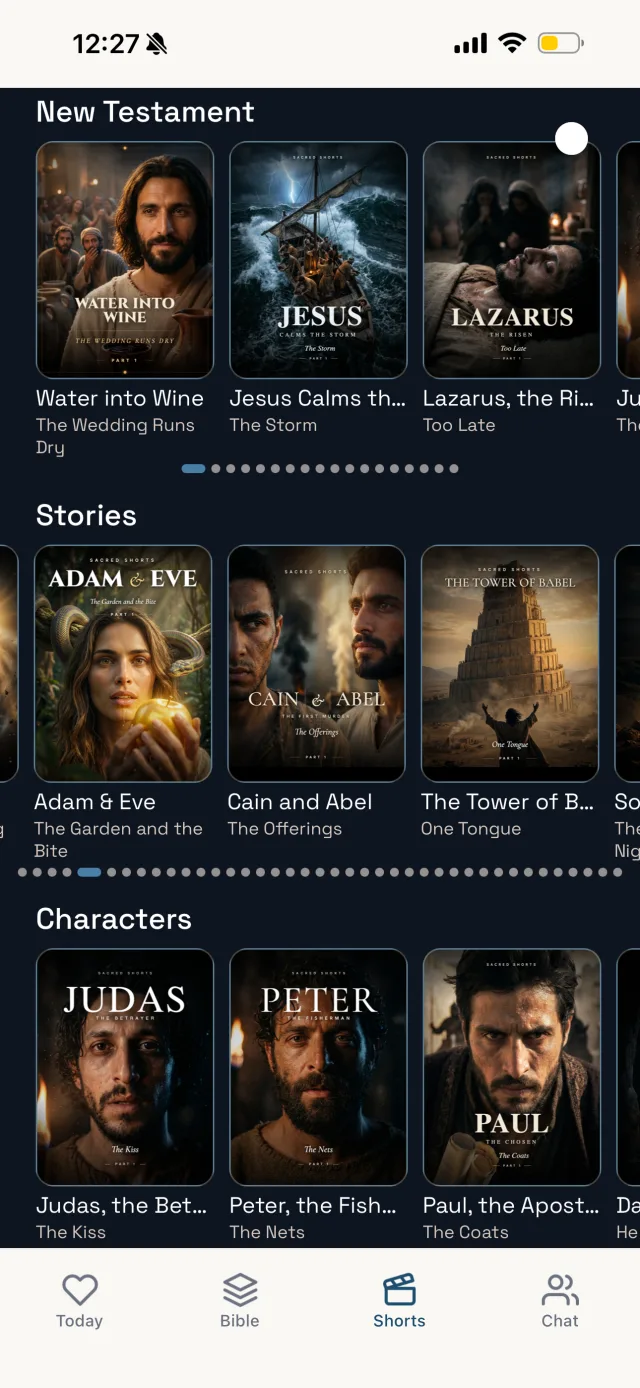
Watch this story come to life as a cinematic series in Sacred.
4.8on the App Store
Key verses about Daniel
- Daniel 1:8 — Daniel resolves not to defile himself, showing conviction in exile.
- Daniel 2:20-22 — Daniel praises God as the giver of wisdom and the revealer of mysteries.
- Daniel 3:17-18 — Daniel's friends confess that God can deliver them, but they will remain faithful even if He does not.
- Daniel 6:10 — Daniel continues praying as he had done before, even under threat.
- Daniel 6:22 — Daniel says God sent His angel and shut the lions' mouths.
- Daniel 7:14 — Daniel sees a kingdom and dominion that will not pass away.
Lessons from Daniel's life
Daniel teaches believers how to live faithfully in exile. He does not withdraw completely from public life; he serves with excellence. But he also does not let the empire define his deepest loyalty. His life shows that Christians can work, lead, and contribute in complicated environments while keeping worship at the center.
Daniel also teaches disciplined prayer. The lions' den story is powerful because Daniel's courage was not improvised. He had a rhythm of prayer before the crisis. When the law changed, Daniel did not suddenly become faithful; he simply continued the faithfulness he had practiced privately for years.
Another lesson is humility with gifts. Daniel had unusual wisdom, but he repeatedly credited God. He did not use spiritual insight to make himself look powerful. He used it to speak truth, serve others, and honor the Lord.
Daniel's life also warns us that integrity can create opposition. The officials who attacked him could find no negligence or corruption, so they targeted his faith. Faithfulness does not always make life easier. Sometimes it makes the cost more visible. Yet Daniel's story reminds us that God is present in the den, in exile, and in history itself.
Daniel's legacy
Daniel's legacy is courage without arrogance, wisdom without compromise, and prayer under pressure. His story continues to strengthen believers who feel outnumbered, displaced, or tested by the culture around them. He shows that faithfulness is possible far from home because God is not limited to Jerusalem, the temple, or comfortable circumstances. The God of Daniel reigns in Babylon too.
FAQ
Why is Daniel important in the Bible? Daniel is important because he models faithful living in exile and receives visions that emphasize God's sovereignty over earthly kingdoms.
What is Daniel best known for? He is best known for interpreting dreams, serving foreign kings with integrity, and being delivered by God from the lions' den.
What can we learn from Daniel? Daniel teaches disciplined prayer, courage under pressure, humility, integrity, and trust that God's kingdom outlasts every human empire.
 Sacred Shorts
Watch the Bible like never before
Cinematic Bible stories, a complete Study Bible, daily devotionals, and guided prayer. New episodes every week.