
The Bible speaks powerfully to the experience of feeling overwhelmed — that sense of drowning under more than you can carry. Scripture doesn't shame the overwhelmed person; it consistently offers refuge, rest, and the promise that you were never meant to carry everything alone. From the Psalms to the words of Jesus, the Bible meets overwhelm with compassion and practical hope.
What Does the Bible Teach About Overwhelm?
The experience of being overwhelmed runs deep through biblical literature. The Hebrew word ataph — used in Psalms 61, 77, and 142 — means to be enveloped, covered, or faint. It describes the sensation of being wrapped in something you can't escape. The Greek bareo (2 Corinthians 1:8) means to be weighed down beyond measure.
Biblical figures experienced overwhelm for different reasons: Moses was overwhelmed by leadership responsibility (Numbers 11:14), David by persecution and betrayal (Psalm 55), Paul by persecution in Asia (2 Corinthians 1:8), and even Jesus by the weight of what awaited Him in Gethsemane (Mark 14:33-34).
What's significant is that the Bible never treats overwhelm as a personal failing. It treats it as a signal — an indication that you've reached the limit of human capacity and need divine intervention. The consistent biblical response isn't "try harder" but "bring it to God."
Key Bible Verses About Overwhelm
Psalm 61:2 (NIV)
"From the ends of the earth I call to you, I call as my heart grows faint; lead me to the rock that is higher than I."
David wrote this psalm during a time when he felt distant from God's presence — possibly during Absalom's rebellion when he fled Jerusalem (around 1000 BC). The phrase "heart grows faint" uses the Hebrew ataph, meaning to be overwhelmed or enveloped. David's response to overwhelm is to cry out from wherever he is — even "the ends of the earth." The "rock higher than I" represents a stability beyond his own capacity. This teaches that overwhelm is the proper moment to seek something stronger than yourself.
Matthew 11:28-30 (NIV)
"Come to me, all you who are weary and burdened, and I will give you rest. Take my yoke upon you and learn from me, for I am gentle and humble in heart, and you will find rest for your souls. For my yoke is easy and my burden is light."
Jesus spoke these words to crowds crushed under the weight of religious legalism — hundreds of rules imposed by the Pharisees that made spiritual life feel impossible. The word "burdened" (phortizo) describes being loaded down like a pack animal. Jesus' invitation is radical: He doesn't say "push through" or "be stronger." He offers exchange — your crushing burden for His manageable one. The "yoke" image is about shared labor: when yoked with Christ, you're no longer pulling alone.
2 Corinthians 1:8-9 (NIV)
"We do not want you to be uninformed, brothers and sisters, about the troubles we experienced in the province of Asia. We were under great pressure, far beyond our ability to endure, so that we despaired of life itself. Indeed, we felt we had received the sentence of death."
Paul wrote this around 55 AD about a specific, intense crisis in Ephesus. The phrase "far beyond our ability to endure" is striking from the apostle who endured shipwrecks, beatings, and imprisonments. Paul is admitting that he reached a point of total overwhelm — he thought he would die. Yet he concludes that this happened "so that we might not rely on ourselves but on God, who raises the dead." This teaches that even apostles reach breaking points, and those breaking points can become spiritual turning points.
Psalm 142:3 (NIV)
"When my spirit grows faint within me, it is you who watch over my way."
David wrote this psalm while hiding in a cave — likely the cave of Adullam when he fled from Saul (around 1015 BC). The physical confinement mirrors his emotional state: trapped, overwhelmed, seeing no way out. Yet even in that dark, confined space, David affirms that God sees his path. This teaches that being overwhelmed doesn't mean being unseen. God watches over your way even when you can't see it yourself.
1 Peter 5:7 (NIV)
"Cast all your anxiety on him because he cares for you."
Peter wrote to persecuted Christians scattered across Asia Minor around 64 AD. The word "cast" (epirrhipto) means to throw with force — not gently place but aggressively hurl. The word "all" means exactly that: every worry, every burden, every overwhelming thought. And the reason isn't God's power (though He has it) but God's care: "because he cares for you." When overwhelm builds, this verse invites an active, forceful release of everything you're carrying.
Matthew 6:34 (NIV)
"Therefore do not worry about tomorrow, for tomorrow will worry about itself. Each day has enough trouble of its own."
Jesus spoke this during the Sermon on the Mount to people who had real, daily survival concerns. His teaching isn't dismissive — it's strategic. Much of overwhelm comes from carrying tomorrow's problems alongside today's. Jesus teaches a radical present-focus: deal with today's challenges today. Tomorrow's burdens belong to tomorrow. This doesn't eliminate difficulty but right-sizes it to something manageable.

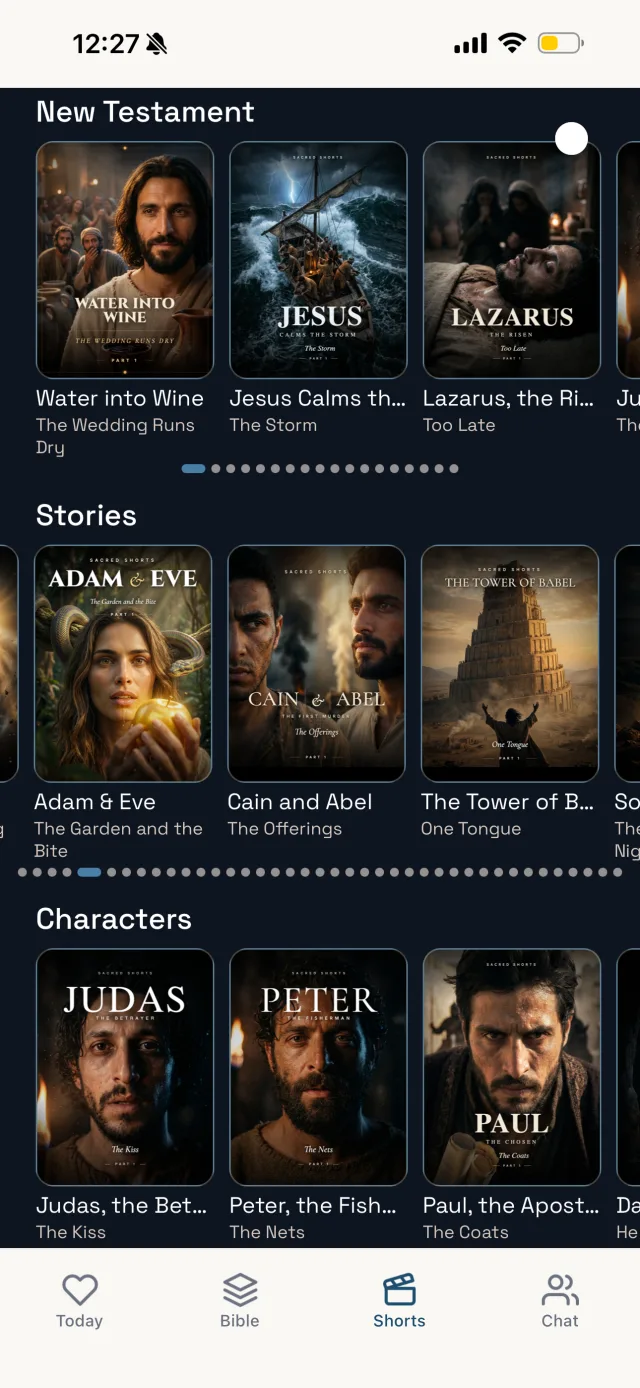
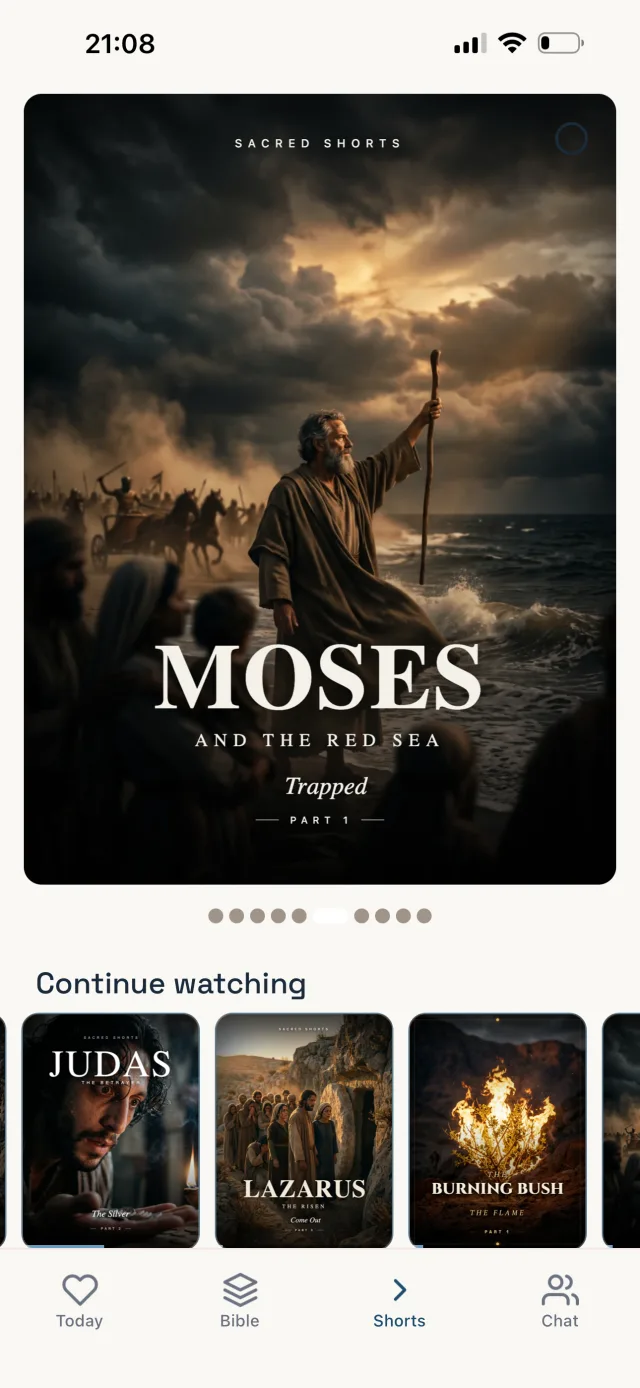
The Bible has never felt like this
Watch this story come to life as a cinematic series in Sacred.
4.8on the App Store
How to Apply These Teachings Today
Overwhelm often comes from trying to carry everything at once, a concept explored in What Does the Bible Say About Anxiety. The Bible consistently teaches that you weren't designed to carry it all — that's God's role.
Practice active surrender. 1 Peter 5:7 isn't passive — it's active casting. When overwhelm builds, name each burden specifically and consciously release it to God in prayer. Writing them down can make this more concrete.
Take the next small step. When everything feels like too much, ask: what is the one thing I can do right now? Jesus taught taking life one day at a time (Matthew 6:34). Overwhelm shrinks when you stop trying to solve everything simultaneously.
Accept your limits as design, not failure. Paul learned that his breaking point became a turning point (2 Corinthians 1:9). Being overwhelmed isn't evidence that you're weak — it's evidence that you're human, and it's an invitation to lean into divine strength. Try Sacred free — your daily spiritual ritual in 6 minutes.
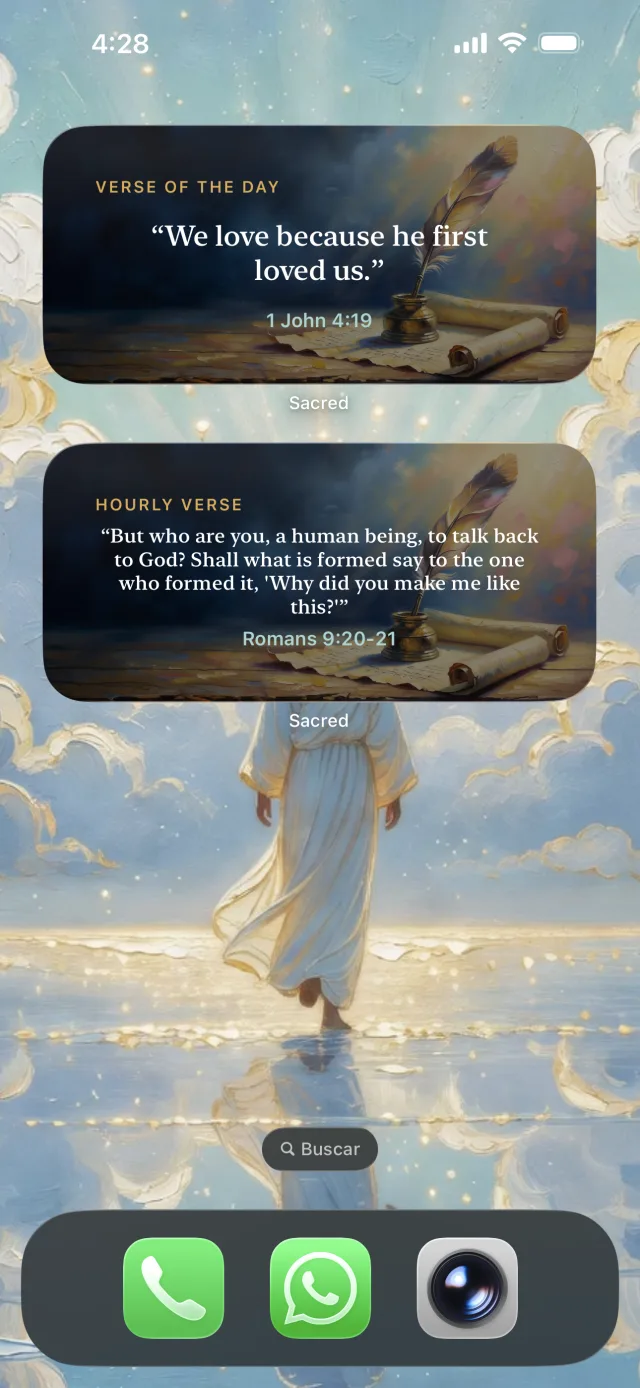
Ready to build a daily spiritual habit? Sacred gives you a personalized verse, guided prayer, and biblical chat — all in 6 minutes. Download Sacred free.
Frequently Asked Questions
What does the Bible say when you feel overwhelmed?
The Bible repeatedly invites those who feel overwhelmed to bring their burdens to God. Psalm 61:2 says "When my heart is overwhelmed, lead me to the rock that is higher than I." Jesus himself invites the weary in Matthew 11:28: "Come to me, all you who are weary and burdened, and I will give you rest."
Is feeling overwhelmed a lack of faith?
No. Many faithful people in the Bible felt overwhelmed — David in the Psalms, Moses leading Israel, even Jesus in Gethsemane (Mark 14:33-34). Feeling overwhelmed is a human response to exceeding your capacity, not a measure of your faith. The Bible models bringing overwhelm to God honestly.
How can I find peace when everything feels like too much?
Scripture suggests several practices: cast your cares on God (1 Peter 5:7), seek rest in His presence (Matthew 11:28-30), focus on today rather than tomorrow (Matthew 6:34), and trust that God's strength operates in your weakness (2 Corinthians 12:9). Prayer and community support are also vital.
 Sacred Shorts
Watch the Bible like never before
Cinematic Bible stories, a complete Study Bible, daily devotionals, and guided prayer. New episodes every week.
Frequently asked questions
The Bible repeatedly invites those who feel overwhelmed to bring their burdens to God. [Psalm 61:2](https://www.biblegateway.com/passage/?search=Psalm+61%3A2&version=NIV) says 'When my heart is overwhelmed, lead me to the rock that is higher than I.' Jesus himself invites the weary in [Matthew 11:28-30](https://www.biblegateway.com/passage/?search=Matthew+11%3A28-30&version=NIV): 'Come to me, all you who are weary and burdened, and I will give you rest.'
No. Many faithful people in the Bible felt overwhelmed — David in the Psalms, Moses leading Israel, even Jesus in Gethsemane (Mark 14:33-34). Feeling overwhelmed is a human response to exceeding your capacity, not a measure of your faith. The Bible models bringing overwhelm to God honestly.
Scripture suggests several practices: cast your cares on God (1 Peter 5:7), seek rest in His presence (Matthew 11:28-30), focus on today rather than tomorrow (Matthew 6:34), and trust that God's strength operates in your weakness (2 Corinthians 12:9). For more guidance, see [How to Pray When You Don't Know What to Say](/blog/how-to-pray-when-you-dont-know-what-to-say). Prayer and community support are also vital, as discussed in [How to Build a Daily Devotional Habit](/blog/how-to-build-a-daily-devotional-habit).