Quick Answer
Exodus 14:14 is the promise Moses gave the people of Israel when they were trapped between the Egyptian army and the Red Sea: God Himself would fight the battle they could not win. The verse teaches that when we face impossible situations, the believer's response is not panic but calm trust in a God who acts on behalf of His people.
The Full Verse
Here is Exodus 14:14 in the New International Version (NIV):
"The LORD will fight for you; you need only to be still."
For comparison, the King James Version (KJV) reads:
"The LORD shall fight for you, and ye shall hold your peace."
Both translations express the same truth with complementary emphases: God takes the initiative in the battle, and the people are called to confident stillness.
Historical Context
Exodus 14 records one of the most dramatic moments in the entire Bible. After centuries of slavery in Egypt and the ten plagues, Pharaoh finally let the Israelites go. But soon afterward he changed his mind and set out in pursuit with six hundred of his best chariots and his whole army (Exodus 14:6-7).
The people found themselves in the worst scenario imaginable: the Red Sea ahead, the most powerful army of the ancient world behind, and no human way out. Their reaction was immediate: "they were terrified and cried out to the LORD" (Exodus 14:10). They even turned on Moses: "Was it because there were no graves in Egypt that you brought us to the desert to die?" (Exodus 14:11).
It is in that moment of collective terror that Moses speaks the words of verses 13 and 14: "Do not be afraid... The LORD will fight for you." What follows is well known: God parts the sea, Israel crosses on dry ground, and the Egyptian army is destroyed. Verse 14 was not spoken after the victory but before it, when no solution was yet in sight. That is what makes it so powerful.
What Does Exodus 14:14 Mean?
The verse contains two short phrases, and each carries a deep lesson.
"The LORD will fight for you"
The Hebrew verb here is "lacham" (לָחַם), which literally means to do battle, to wage war. This is no soft metaphor: it presents God as a warrior who personally enters the conflict. In Exodus 15:3, after the crossing, Israel sings, "The LORD is a warrior; the LORD is his name." The point is not that God helps a little while the people do most of the work; God takes on the entire battle. At the Red Sea, Israel did not fire a single arrow. The victory belonged wholly to God, so there would be no doubt about whose power had saved them.
"You need only to be still"
The Hebrew word is "charash" (חָרַשׁ), meaning to be silent, to hold one's peace. The KJV renders it "hold your peace." It is a startling command: at the moment of greatest danger, God does not ask for shouting, strategies, or desperate effort, but for trusting silence. That silence is not passivity or resignation; it is the deliberate decision to stop fighting in your own strength and hand control over to God.
The balance of the very next verse
Exodus 14:14 should be read together with verse 15, where God says to Moses, "Why are you crying out to me? Tell the Israelites to move on." Stillness of heart and obedience of the feet go together. God fights the battle, but the people still had to walk toward the open sea. Trusting God is never an excuse to avoid taking the step He has already shown us.

The Bible has never felt like this
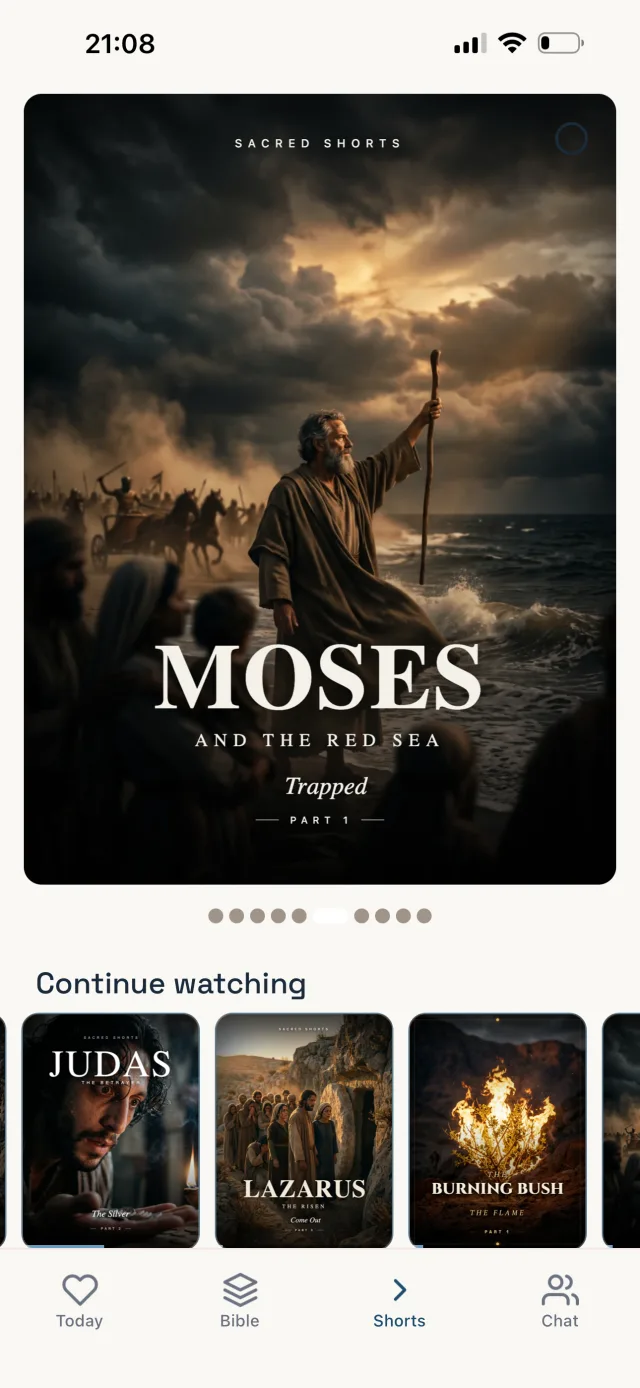
Watch this story come to life as a cinematic series in Sacred.
4.8on the App Store
What Exodus 14:14 Teaches
The central teaching of Exodus 14:14 is that some battles are not ours to win but God's. The people of Israel had no army, no weapons, no escape plan. Their only contribution was to trust and move forward. This pattern repeats throughout Scripture: in 2 Chronicles 20:17, God tells King Jehoshaphat almost the same words: "You will not have to fight this battle. Take up your positions; stand firm and see the deliverance the LORD will give you."
The verse also teaches us something about God's character. He is not a distant spectator of our struggles: He gets involved, defends, and acts. And it teaches us something about ourselves: the human instinct in a crisis is panic or control, but mature faith learns to be still. As Psalm 46:10 says, "Be still, and know that I am God." The calm that Exodus 14:14 calls for does not come from the problem being small, but from God being great.
How to Apply Exodus 14:14 to Your Life
Sooner or later we all face a "Red Sea": an unexpected diagnosis, a financial crisis, a family conflict we cannot resolve, a situation with no visible way out. Exodus 14:14 offers a practical path for those moments.
First, name your battle before God. Instead of replaying the problem a thousand times in your mind, bring it to prayer concretely: "Lord, this situation is beyond me; I hand it over to You." The people cried out to God before they saw the answer, and that cry was the beginning of their deliverance.
Second, practice stillness. Set aside a few minutes each day for silence before God, not asking for anything, simply remembering who He is. Meditating on verses like Isaiah 41:10 can help calm anxiety with concrete truths instead of spiraling thoughts.
Third, take the step that is in your hands. Being still is not being paralyzed. Ask yourself: what does "move on" look like in my situation? It might mean asking for help, having a conversation you have been avoiding, or simply continuing to carry out your responsibilities faithfully while God works on what you cannot control.
Finally, remember past deliverances. Israel sang after the Red Sea (Exodus 15) precisely so they would not forget. Keeping a record of answered prayers strengthens your confidence for the next battle.
Related Verses
Isaiah 41:10 (NIV): "So do not fear, for I am with you; do not be dismayed, for I am your God." — The same promise of God's presence in the midst of fear, spoken to a people in crisis.
Joshua 1:9 (NIV): "Be strong and courageous. Do not be afraid; do not be discouraged, for the LORD your God will be with you wherever you go." — The call to move forward with courage because God goes with us.
Psalm 23 (NIV): "The LORD is my shepherd, I lack nothing." — God's care that brings peace even in the darkest valley.
2 Chronicles 20:17 (NIV): "You will not have to fight this battle. Take up your positions; stand firm and see the deliverance the LORD will give you." — An almost literal echo of Exodus 14:14, centuries later.
Psalm 46:10 (NIV): "Be still, and know that I am God." — Stillness as an act of worship and trust.
Exodus 14:14 reminds us that the God who parted the Red Sea still fights for His people. If you are facing an impossible situation today, this promise is for you too: trust, be still, and move forward. You can explore more studies like this one in our verse meanings section.
 Sacred Shorts
Watch the Bible like never before
Cinematic Bible stories, a complete Study Bible, daily devotionals, and guided prayer. New episodes every week.
Frequently asked questions
It means God actively steps into the battles that are beyond your strength. Exodus 14:14 shows that victory does not depend on your ability but on the faithfulness and power of God.
No. In Exodus 14:15 God commands the people to move forward. Being still means you stop fighting in your own strength and trust God while obeying the next step He shows you.
Yes. Though spoken to Israel at the Red Sea, the verse reveals God's unchanging character: He defends His people, and that promise still brings peace to believers facing anxiety and trouble.